Monday, 29 April 2013

Turn your head


TURN YOUR HEAD

Turn your head.  Can you see her?  
That little girl with the dark hair, running down the track? 
There, by the gorse bushes, air heavy with their scent of coconut,
Sunshine burning skin like a magnifying glass.
She’s gone, with a twirl of cotton skirt, round the bushes
In search of ponies.  Always ponies in her life.
 Always somebody else’s. 
There they stand across the valley, in the shade of the holly grove,
Eyes watchful, ears flicking backwards and forwards,
Tails switching flies on sun-warmed flanks,
Foals dreamily blinking and snoozing at their feet.

The stream takes her attention, warm peaty brown water
Swirling over the gravel pebbles, discolouring them, distorting them,
Forming little eddies around the rocks, tickling heather,
Bouncing the branches of broom which dangle over them,
Licking at the banks, curvaceously meandering,
Trespassing under tree-roots, plashing and splashing and
Clunking stones.  It is home to minnows and sticklebacks,
Waterboatmen and whirligigs, a drowner of insects,
Highway for flotillas of fallen leaves, stealer of shadows,
Thief of foxglove flowers, home of Guinness-coloured pools
And embroidered skeins of bubbles.


 The sultry breeze jangles the ash keys like loose change,
Tickles the willow leaves, combs the flossy hair of the bog cotton,
Chimes the heather bells, rattles the gorsepods till they explode like artillery,
Sidles round the bracken stalks and plucks at ponies’ forelocks.
 It carries the notes of the skylark, the scent of the Sweet-gale,
The wing of the buzzard and the hum of the bees.
It skips through the marshes and breaths on the peat-moss,
Exhaling a summer song under the trees.


Thursday, 25 April 2013

Llandeilo Tal-y-Bont church, St Fagans


As a comparison for the frescos in Kempley Church - how they might once have looked Pre-Reformation - this is the church of Llandeilo Tal-y-Bont, originally by a curve on the River Llwchwr on the marshes at Pontardulais, and now faithfully rebuilt at St Fagans - the Museum of Welsh Life at Cardiff.  It was well known by Edward Thomas, who once famously wrote of sheltering in the porch in a thunderstorm and watching the incredible lightening across the marshes.  (He and Robert Frost were also very familiar with Kempley!)   I met a lovely lady recently, whilst I was volunteering, who knew this church well when it was still in use, and she told me that "everyone went to services there.  It was very popular with the young folk too, and the pathway to it was called "the monkey walk"!!!  I daresay a good few courting couples remember the church too.


Now, when the church  - which had sadly fallen into disrepair since being deconsecrated around 1970 - was being dismantled around 1984 prior to taking it to St Fagans, they found the most amazing Medieval paintings - all carefully whitewashed over of course from Cromwellian times.  They span quite a few periods, but most date from 1490 to 1530.  These pictures give you an idea of the colour and magnificence of some of our early churches.  Christ on the Cross and above him, Noah and his ark.


Imagine the chequerboard windows of Kempley in their full glory, like this archway.


The Last Supper, and is the previous one Christ's journey to Jerusalem?


St Christopher, who would grace the wall opposite the entrance, for the benefit of travellers and pilgrims.  Presumably you would need a bit of help to cross the River Llwchwr, which is still tidal at this point.  If you subsequently died, once you had seen St Christopher 's image,  you would then go straight to heaven

.
Saints (or disciples?) and scenes from Christ's passion. 

The name of the church, by the way, derives from the Llan (holy meeting place) of St Teilo, by the crossing place/bridge across the river.  Llandeilo tal-y-bont.  A church was on that site from the 6th century onwards, although the rebuilt church dates from the 13th C.


HERE is an interesting blog link, which gives you much ore detail about the church.

Tuesday, 23 April 2013

Someone has it in for me!


Well, I didn't think I would be posting today to say that instead of getting better on the steroids and antibiotics, I have actually gotten WORSE and now have Pleurisy!  I have spoken to my GP who didn't seem as concerned as I feel (!) and just said to up the steroids for another 3 days before gradually ending the course.  That should do it . . . apparently.  Let's hope so, as the pain in my back and behind my shoulder blades is rather unpleasant.

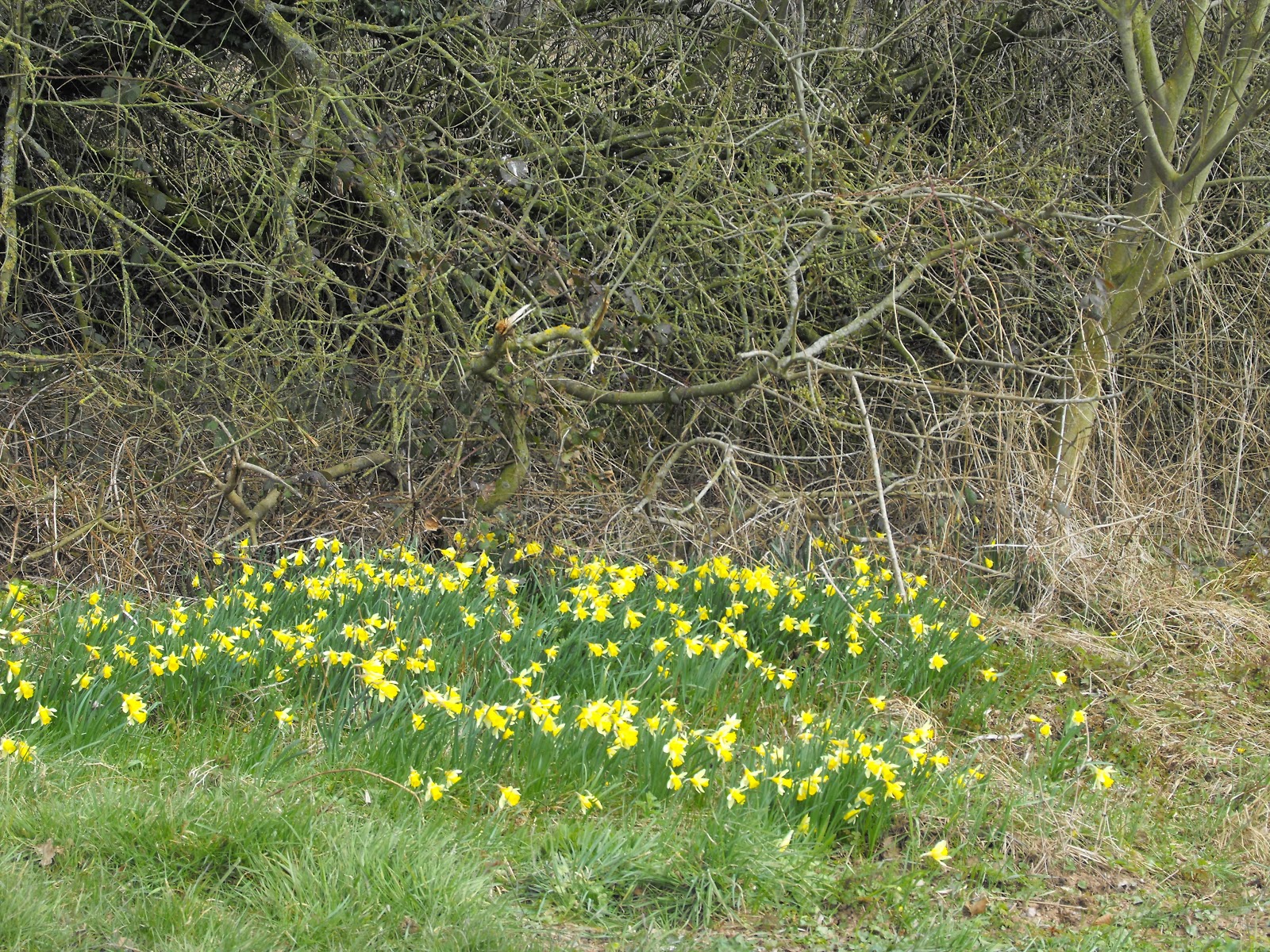
Anyway, I can manage to post a few photos.  This top one is a patch of wild Daffodils near Kempley in Gloucestershire (right on the border with Herefordshire).  This indiginous wild sort would have been the ones that Wordsworth wrote about - throw all thoughts of the gaunt modern King Alfreds from your mind please.

We went to Kempley Church first.  Still too early for a big mass of daffodils I think, and without my friend J we didn't know the best places to look, but they will be there next year . . .  Kempley Church was very quiet this time.  No special atmosphere that it had last year. 

I don't know what it is about such spots, but they truly seem to link in with the landscape.  There are several places I could name (York Minster for one, parts of Avebury - nay, the entire area of Avebury, Gloucester Cathedral, and this church) where there seems to be a connectivity to . . . a divine feeling.  That's the nearest I can come to describing it.  At York it is like a pillar of pure energy flowing up through in one spot in - I think it's the Chapter House.  This little church has it too, but it is more of an . . .earth energy . . . almost like a heart-beat.  Strange.  There's a little church on the Devon coast my friend went to, which had this feeling in such bucketfuls she nearly passed out . . .  Explain it we can't, but it's there all the same.


Someone (on the Parish Council?) had decreed that it be limewashed in pale pink.  I didn't like it.  It might work in Suffolk, but not here.  Bring back the white, say I.


I hope that you can read this or are able to enlarge it if you can't.  Of the beautiful tympanum (guess who forgot a photo?) it says:  'The entrance to a Norman church was a focal point for symbolic imagery.  The carved tympanum at St Mary's, between the arch and the lintel over the south door, depicts the Tree of Life, a symbol of Christ's salvation'.  It dates to around 1130 and is similar to that at nearby Dymock church (which I visited, and also failed to take a photo as I was concentrating on the Dymock poets exhibition end of the church . . .)  Smacked wrists!


The lovely Gothic Norman archway between the Nave and the Chancel (which looks deliciously wonky, as I dare say they didn't bother with footings much in those days.)  You can just see the chequerboard of the Norman wall paintings and the echoes of others in the Nave. These are apparently "the most complete set of Romanesque frescos in Northern Europe.  Here is a LINK to the history of Kempley from Wikipedia.


And here is the other side, with paintings, looking back to the little escape doorway? at the end of the nave, leading into the tower.  Probably defensive - there is one just like it in the 12th C church opposite Manorbier Castle in Pembrokeshire. 


This LINK will tell you all about the wall paintings, which  span two dates.  The ones in the Chancel date from the 12th C and were painted directly onto wet plaster. 

The Wheel of Life, above, in the Nave, dates from the 13th C, when all the frescos were painted using tempera (egg albumen mixed with pigments) on dry plaster.  The Wheel of Life shows the ten Ages of Man.


One of the window apertures showing the  painting of  Heavenly Jerusalem.

How much we have lost over the Millennia, with the painting over of such frescos by the zealous Parliamentarians.  What colour.  What design.  What craftsmanship.  When I was younger, I used to poke fun at the old people who used to be interested in Church architecture and history.  Now I am one of them!

Monday, 22 April 2013

Car booting and crafting


AT LAST!  Spring is with us, and a green blush is beginning to spread across the land, highlighting the wood margins and hedgerows, and creeping across meadows.  I have millions of tadpoles in both ponds, the Marsh Marigolds have turned the wet woodland to gold, and the Swallows are back.  Not "our" stable ones yet, if they have survived the journey to and from Africa, but other local ones, and it lifts my heart to see them swooping and soaring above the house and farm.


Saturday was a warm sunny day from first light onwards, though it began with a frost and a temperature of minus one.  I know this for a fact, as we dragged ourselves up at 5 a.m. to go down to the big car boot sale in Swansea.  We had a great morning down there, just strolling around the stalls.  We used to go there regularly when the children were younger, but hadn't been down there for years.  Unsurprisingly, it was very busy for it usually is by this time of year.  Sellers have to be there by 6 a.m. at the latest and by mid-summer, I dare say it is an even earlier hour.  Folks used to say if you weren't there by 3 a.m. to sell, don't bother.  Personally, if I had to spend most of the night trying to sleep in my car in a car park to get a pitch,  I would want a guarantee of selling everything I had packed!!!  But we went to buy . . . which is a different matter.

You can easily tell we are living in a recession by what people are selling.  There were a LOT of mums selling childrens' clothes (and toys too).  In fact, there were quite a few dealers selling 2nd hand clothing generally, and I would say a good half of the people walking round were buying clothing.  Heck, even I bought clothing!  Mind you, I was after stuff to "upcycle".  I don't care for that word - "re-use", turn into something else (the rag rug book I bought 2 weeks ago has REALLY got to me!)  I got several pieces - old dresses and skirts - as colourful as possible - for 50p or £1, and they're now washed and I have started unpicking the stitching.  (All I could do yesterday, as I was stapled to the sofa with my brain in another room as I am back on Steroids and anti-biotics for a chest infection, and 3 hours sleep does nothing for the mental processes . . .)

Anyway, as always at such places, there were lots of dealers who just sell new stuff like batteries, nails, cheap tools, garden stuff, bird food and pet food, dog beds - that sort of thing.  Then there are the dealers with the house clearance items - some general with bits of furniture, bedding, curtains and others more rusty old tools and  implements and boxes full of more rusty objet rubbish . . .  These stalls are a magnet for my husband and I usually leave him to ferret around whilst I go on further and normally get drawn in by boxes of old books.

Right in the middle of the boot sale is a burger bar, which has a few chairs for customers to take their ease on.  It looks rather incongruous having patio chairs stuck in the middle of a sea of people, although the view across Swansea Bay on such a day was sublime.  On a clear day, the North Devon coast is clearly visible and I always wish myself there .  .

So, as we wandered round, my husband bought a few old tools, as is his wont, and two really good woodworking (turning) chisels at £2 each were a real bargain.  He is the furniture-mender here, and has turned some junk into gems down the years.  We marvelled at the size and strength of the man who had once wielded a scythe whose handle had been made from the BIG swingle-tree from a cart.  The scythe handle is normally a turned and shaped pole with the length being critical to the height of the person wielding it - imagine having to work all day with something that is just a couple of inches too long or too short.  Your muscles would soon be screaming.  This swingle-tree handle was something else, since it was made from oak! From this stall an old pitchfork came home with us. 

I couldn't resist a couple of cookery books - the Gordon Ramsey "Great Escape" book on Indian cookery - brand new and only TWENTY PENCE!!! and what was probably an unwanted Christmas present from another stall, "Boutique Baking" for a pound, which had some gorgeous looking confections - you never know, I may be called in to do the wedding feasts for my offspring, and then this would come in handy . . .

I found a gorgeous modern collapsible lampshade (new) in a pretty print, for T's new rented house, and an old Victorian jug in a design I've always admired - stag and dalmations (well, spotty dogs anyway), which because the handle had been off at one point and reglued, was only £1.  Once up on my beams, the broken handle isn't noticed. I even bought my first Tomato plant for the season (Moneymaker).  I put my plastic greenhouse up last week and it is full to bulging with seed trays already, so one was all I have room for until I get the other seed stack up in the yard.

A few speculative buys too, and all in all a day well started.  I even got to do the grocery shopping at Sainsburys, which is my preferred supermarket, but the nearest one is at Swansea.  I treated myself to a copy of "Making" magazine.  A real indulgence, but it had some good ideas in, and I tend to keep my craft magazines for years and years (if not forever) so I look on it as an investment . . .

There is still more of my birthday outing to yet report, but hopefully I may get a chance to put up some photos later today.


Tuesday, 16 April 2013

St Mary's Tithe Barn, Abergavenny


After looking around the church, we made our way to the Tithe Barn, which has been beautifully restored and turned into a Foodhall with local produce, and with a display about the history of Abergavenny upstairs.  We were most impressed, and my husband (NOT a foodie by any means!) even said he would have liked a meal there if we hadn't been going on into Herefordshire.  So we shall return.  This magnificent tapestry sketches out the history of Abergavenny and the Marcher Lords, and its place in Welsh history.  You can clearly see the Jesse figure on the bottom left, and Owain Glyndwr is mounted on a beautiful chestnut cob on the far side.  The town is in the centre, with a backdrop of the Brecon Beacons, and a Red Kite flying above it all.  How wonderful to have been involved in creating such a beautiful heirloom. A team of some 60 needlewomen dedicated nearly four years into stitching this.

From the Abergavenny Tapestry page, the following details:


  • St Benedict, founder of the Benedictine Order of monks. St Mary’s Priory, founded in 1087, as a Benedictine priory.

  • One of the world’s finest pieces of medieval sculpture, the Jesse Tree is a 15th-century carving of Jesse, the biblical father of King David and ancestor of Christ. It rests in St Mary’s Priory Church.

  • Owain Glyndwr, the leader of the Welsh rebellion against the English in the 15th century, who sacked Abergavenny in 1404.

  • Sir Harry Llewellyn, the famous showjumper and his horse Foxhunter, who won Olympic gold in 1952.

  • The effigy of Margaret, betrothed to John de Hastings at the age of 12. Her pet squirrel is said to have caused her death in a fall from the castle ramparts when she was 13. Her tomb lies in St Mary’s Priory Church.


A close-up of the beautiful carving of Jessie.  Above him flies the red dragon of Wales.  There are little individual panels all along the bottom of the tapestry, but sadly I didn't study them too closely to tell you what each is.  You can just see the little red squirrel of Margaret (got it wrong the other day, when I thought it was Eva de Braose's)  below Jessie's head. 


Close up of the centre portion, showing the Sugarloaf mountain, the Castle on its motte, the town behind it, a fox hurriedly leaving the picture, and black and white Friesian cattle in the foreground, with the bridge across the River Gavenny.


A rather blurry close-up of Sir Harry Llewellyn and his famous show jumper "Foxhunter" who won Britain a Gold in the 1952 Olympics at Helsinki.  I remember them well.  Foxhunter had a split in the top of his ear.  He is buried on the Blorenge mountain and a nearby car park bears his name. 


There's a Welsh Cob for you - Owain Glyndwr surveys the scene . . .


I hope you have enjoyed.

Monday, 15 April 2013

Better than jewels by far


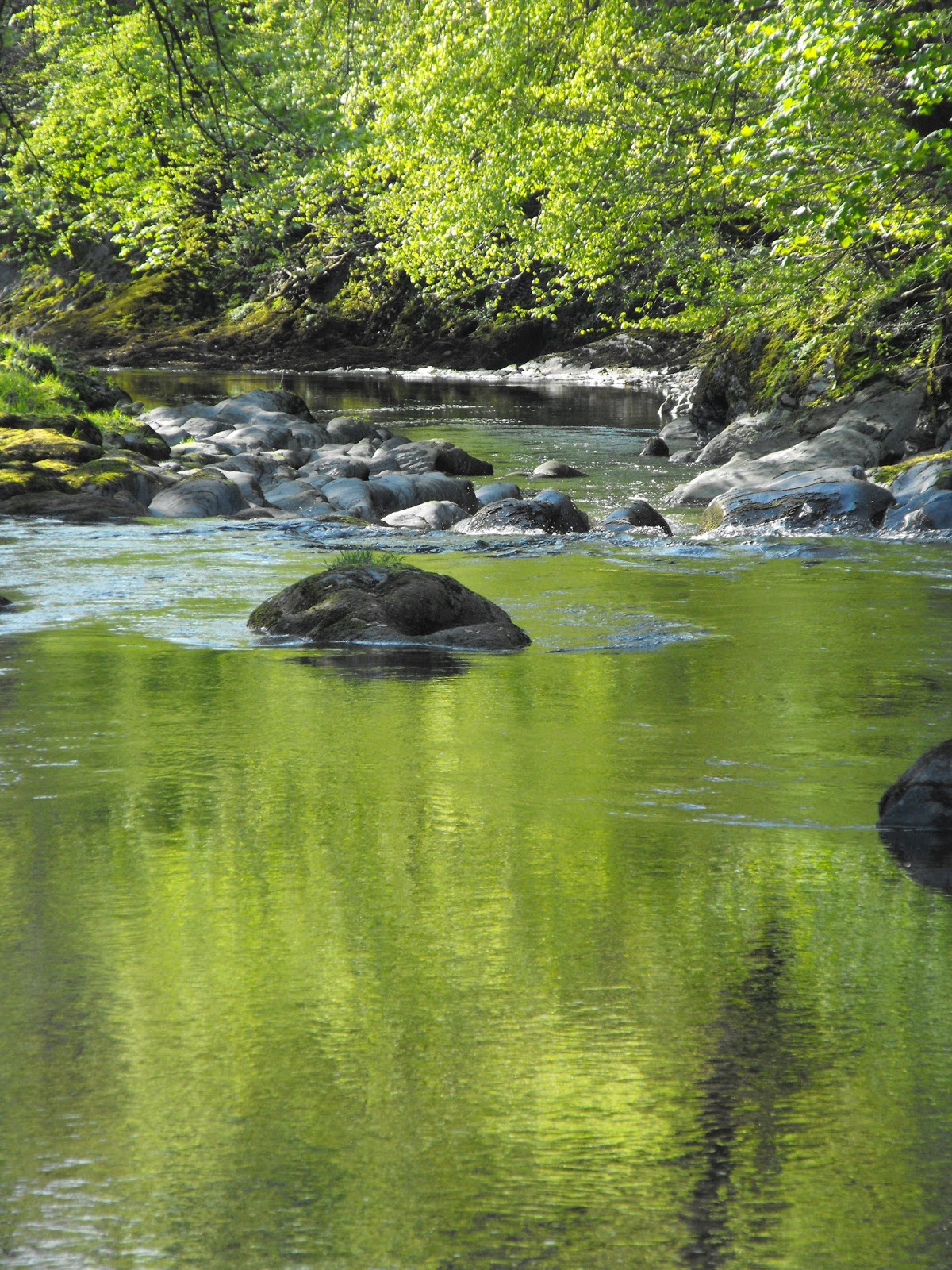
Just a quick update before I go on to Part II of my birthday bash!  I wish it was as green along the river now, as in this photo above, but we are slowly getting there.

We had a good morning at the car boot sale yesterday, despite torrential rain, and I have to say, getting bargains is better than jewels by far to me!  I found a Karen Maitland book I'd been looking for - hardback too - Falcons of Fire and Ice; a brilliant book on Rag Rugging (all sorts of projects in there and in typical Aries fashion I want to make them ALL!).  I found a virtually brand new slow cooker for T for a couple of pounds (works well, as I tested it yesterday and made a beef casserole in it).  Then a pretty very early Victorian jug (small one) which has gone up on a beam; and half a roll of 1985 Laura Ashley material - chestnut brown with  a thin black and white stripe and oak leaves either side of the stripe.  Looks nicer than it sounds.  I also got T a 1970s round cushion with broderie anglaise edging and a crochet centre with a ribbon through.  JUST her sort of thing as she loves vintage.  My husband got plumbing bits and a cracking old Victorian axe made by Gilpins of Cannock.  I shall have to behave myself now!


Friday, 12 April 2013

Part II of my birthday outing - the Misericord figures at St Mary's Priory Church -


Apologies for the delay in getting this all set up but I've had a busy week, with a Horspital appt, blood tests etc and offspring visiting and leading me astray with celebratory red wine!  Anyway, hopefully I will be able to post a few more photos today without having to store them on Picasa first!

I fell in love with this little dragon carving on the Misericords (top photo).  Like the Jesse figure, he dates from the 15th Century.  I think this lion-headed one is an English dragon.  He looks like his head and possibly wings have been cut off and then stuck back on or even re-carved (bless them) - perhaps the ravages of the Cromwellian henchmen in the area.  And he has friends . . .


This twisty dragon looks a nastier piece of work altogether!, although it would appear he too was decapitated at some time (and possibly lost his tail too).  Perhaps this one is the fierce Welsh dragon!

Then there is a lovely Mastiff:


He is worn smooth from years of stroking . . .


Opposite him is this little lion,  another one who had his head knocked off and had it replaced in later times judging by the change of colour.  I love his tawny tresses.  So beautifully carved.

There is a beautiful female effigy (well two actually) in the Lewis chapel, which is believed to be that of Eva de Braose, who died pursuing her tame red squirrel around the castle walls (she fell . . .)  "Someone" (we can guess who was to blame) chopped that squirrel off, but she still wears the chain around her waist, to which it was attached.  I forgot to get a photo as we were so stunned by the Jesse figure.  Next Time.

If the name of de Braose seems familiar to you, it may be because you have read Lady of Hay by Barbara Erskine (her best book, in my opinion).  I have read it several times now and it has a lot of immediacy for me, because I know the area quite well.  William de Braose (who would have been a benefactor of this church) was a thoroughly nasty piece of work, for all his (sham?) piety  . . . 

 Because of the connection between the Lords of Abergavenny and the Tudors, the Priory became the Priory Church at the time of the Dissolution of the Monasteries.    The Herbert chapel was saved from damage because of Sir Richard Herbert's connection with the young Henry Tudor (they were raised at beautiful Raglan Castle together) and Henry became Henry VII after Bosworth.  In the details about St Mary's on Wikipedia, Sir Richard Herbert's support of Henry Tudor at the Battle of Bosworth was noted.


Some of the stone carvings were a little . . . ambivalent?  I think this was a lion, or a lamb, though it looks like a camel with modified ears too!!!


I think this was a calf (fatted or otherwise?) as it had a cow-type tail.  Might be a sheep though . . .  St Luke had an Ox as his symbol and St. Mark had a Lion . . .


Another photo to try and give you an idea of how large the carved animals in the footrests are. As you can see, this is one of the memorials which got hacked about a bit and two arms are missing . . .

Another one with a calf/lamb??? query over it.  Though you could say that's a dog's tail . . .