Friday, 7 March 2014

Cornish trains of thought


What an absolutely lovely day today - sunshine from start to finish, and really quite warm. Warm enough, in fact, to take a cushion and sit on the low wall in the yard, and start reading one of the two books my dear friend Ann sent me today. As usual, new reading matter can eclipse the lure of a just-started book (in this case it was Philippa Gregory's The White Princess - I was just a chapter or two in, but my attention hadn't been fully grabbed. )


However, then I was torn between Jonathan Smith's "Summer in February", about artist Sir Alfred Munnings, and his time spent at the artists' colony at Lamorna in Cornwall, in those halcyon days before WW1, and Barbara Erskine's The Warrior's Princess, which is set along the Welsh marches and harks back to the time of Caractacus, and his and his family's imprisonment and journey to Rome. It was so like a summer's day today, and I felt in the mood for Cornwall, and so I sat down with Summer in February, and am 50 pages in now. As I gardened later on, my thoughts were drawn to Cornwall. I thought of Thomas Hardy meeting Emma Gifford, who was to be his first wife, in the parish of St Juliot, and their losing a little glass in a stream (I think they were picnicking near Beeny Cliff). I thought of Lamorna, and sang a few words from a folk song I remembered from my Dorset days. Gosh, that took me back - to the early 1980s for Dorset folk, and the late 70s when I belonged to a Folk Club in Salisbury. Lamorna also took me back to the books of Derek Tangye, and their cats and donkeys, and the tiny cottage they lived in near Minack, close to Lamorna Cove, from the 1950s onwards. They earned a living supplying early flowers for the London market, and I can remember them sending them in little bunches - on the milk train I think - flowers just set to open, and then gradually over the years the demand was for ones in tight bud. They made up little Cornish posies too, but the demand for these also faded. Their way of life was one of the inspirations which led to me living in a wet Welsh smallholding, with a semi-derelict house and a young family! I envied them their freedom, their choice of lifestyle, and the happiness they shared with their animals. These books are being republished now, so if you haven't read any of them, you are in for a treat. Then I had a Daphne du Maurier moment - she is an author I have always been fascinated by and I have read many of her novels over the years (some several times), and have a small collection of biographies about her. I thought of spooky Jamaica Inn (it has just been sold, I believe, for an eye-watering two million pounds!) and of course, Rebecca, and the house which inspired Manderley, Menabilly, owned by the Rashleigh family, and which du Maurier fell in love with, despite its decrepit state, and she and her family loved in for many years. I remembered going to Fowey when the children were much younger and we were staying with my husband's cousin and family. We crossed on the ferry from Polruan to Fowey, and I can still see in my mind's eye, Daphne du Maurier's house "Ferryside", snoozing in the summer sunshine, with the wind skiffing the waters of the river, and the sunlight glinting of the choppy wavelets. It was easy to imagine du Maurier, and her husband "Boy" Browning sailing up the Fowey in their yacht "Ygdrasil". My children were being absolutely awful, and then I realized that it was long past lunchtime, and once we all had bags of chips, they became more amenable, and we spent a long while in a bookshop, where I bought "The Romance of the Stones" about Cornish archaeology (mainly Neolithic). Then my thoughts came full-circle when I looked at the Munnings painting on the cover of the book - his wife, I believe, riding side-saddle on a beautiful dark brown Thoroughbred, the darkness of the painting lifted by the long-tailed white jacket and full brimmed white hat she is wearing. I was then transported back to Dorset, and another - huge - Munnings canvas of his wife on her favourite hunter, in the Russell-Cotes Museum. The background is a slapdash greenery laid on thickly with a pallate-knife, but the horse is in superb detail . . . Oh - and the gardening went well too!! Apologies for the lack of spacing - I have a new hard drive, and yet Google bloger tells me I have an "error on page" and I am having great problems. Deep joy . . . Hence the lack of photos too.

Monday, 3 March 2014

Preparing for the Estate Agent


There is a LOT of tidying up here to do, both inside and out, before we can get the Estate Agent in to take the photos for the brochure and to sort out the video as well.  I spent the morning, which was raining on and off, sorting the house out and made very good progress.  Mid-afternoon the sun came out and I couldn't resist going out to start tidying up at the bottom part of the yard, the patio and little garden which were my mum's.

As you can see from these photos, there were oak leaves EVERYWHERE.


Plus moss all  over the patio, and grass growing inbetween the stones. 


Here the gravel is full of leaves and weeds, and has moved down to the bottom, so I will have to level it out.  Plus I need to remove some of the small bits of rubble still remaining after the builders had been at work last summer.


This was originally the old Dairy and is joined onto and part of the main house, although it looks like a separate cottage.  The rose to the left is an early-flowering one with a beautiful perfume.  It was a cutting a neighbour gave me, which apparently originally grew in Gelli Aur park.


Progress!

Believe it or not, the Feverfew (self-seeded) to the right of the door, actually has flowers on it!

Anyway, it is heading in the right direction and wasn't too tiring.  It was good to be outside again and making progress.

Saturday, 1 March 2014

St David's Day


March 1st is a special day in Wales, as it celebrates the Feast of St David, who died on this day in 569.  Traditionally, Welsh folk will wear a Daffodil or a Leek, usually ones made from felt (vegetable leeks being a tad large for the lapel!)  School children will celebrate the day by taking part in an Eisteddfod within their school  - a celebration of singing, reciting, folk dancing, musical prowess, poetry and acting. Children in Junior school dress up in traditional Welsh costume.

Of course, my children are grown up, and spread across the world now, and only G is still in Wales and I'm certain she won't have dressed up today!!!

 However, here in Carmarthen, when we went into Tesco for the weekend Telegraph newspaper, there was a Welsh Male Voice Choir singing their hearts out and collecting for charity.  I have to admit lingering by the magazines for four songs, as I was enjoying it so much.  I was hoping that they would sing the lovely Welsh lullaby, Suo Gan, although having listened to it later on Youtube, I think I would have been reaching for my hankie.  HERE is a link to Katherine Jenkins singing it, with a traditional Harp accompaniment.  The Bryn Terfil version is beautiful too, but if you want to run out of hankies, listen to the choir of King's College, Cambridge.

I started reading a library book recently which mentioned this song.  I couldn't get on with the book, but have a vivid picture of the pit disaster, and men and boys trapped below ground, singing Suo Gan in perfect harmony, very quietly,for comfort.  That picture haunts me still.

I would like to think that my Grandfather, George Hobbs, might have known this song well.  He was a coal miner around the early 1900s, when his family - his mother had been widowed and remarried, and her new husband and 2nd family -  moved to Aberbargoed for work.  She was born in Somerset (Galmington in Taunton in 1867), moved to London, married there, and then ended her days in Wales.  My mum could remember going to Wales for Christmas, all the children packed into their two up two down miner's house in Nenaddwen Street, and said that they would sleep top and tail in the bed.  My aunty was telling me a couple of weeks ago that the Christmas stockings for the children, hung on the end of the bed, were dirty smelly old mens' socks!!!

Grandad stayed until the Miner's Strike of 1912, but then walked to Newport and joined the Army.  His parents and family stayed on in Aberbargoed, although his brothers and half-brothers all joined up, from what I remember.  His stepfather -William Brown, died in 1952, aged 78, and his mother, Emily Martha Brown (previously Hobbs, maiden name Payton, of Glastonbury) predeceased him in 1946, aged 79.  I asked my aunty what she could remember about her - the photos show a stout lady with a marvellous complexion even well into her 70s (I know who I inherited mine from now)   She always wore black, apparently, and was very Victorian in her ways, and hardly spoke at all - just looked rather disapproving I think, but then as a child you might be inclined to think that.

Anyway, whether you have Welsh blood or no, a Happy St David's Day to you (albeit slightly late in the day to wish it!)


Thursday, 27 February 2014

This walk was Hard Work!


It was dry again yesterday and I set off for a walk along the valley, towards the A40.  The river had dropped but there was still a fair bit of power there.  It wouldn't do to fall in, that's for sure.  I never tire of the river - it changes from day to day, and when it has been raining, from hour to hour.  The speed with which it can rise is quite frightening.  Our friends along the river live in dread of the phone call in the wee small hours, warning them of a red alert . . .


The lane ahead, with sunlight brightening the olive green of the moss on the steep banks and changing it towards emerald.  I think I can just see a couple of leaves on the bushes atop it (on the left).  Possibly honeysuckle or more likely, elder, as I have big buds on my elder shrubs in the paddock and yard.

 For once, I even got droplets of water in the spume!  


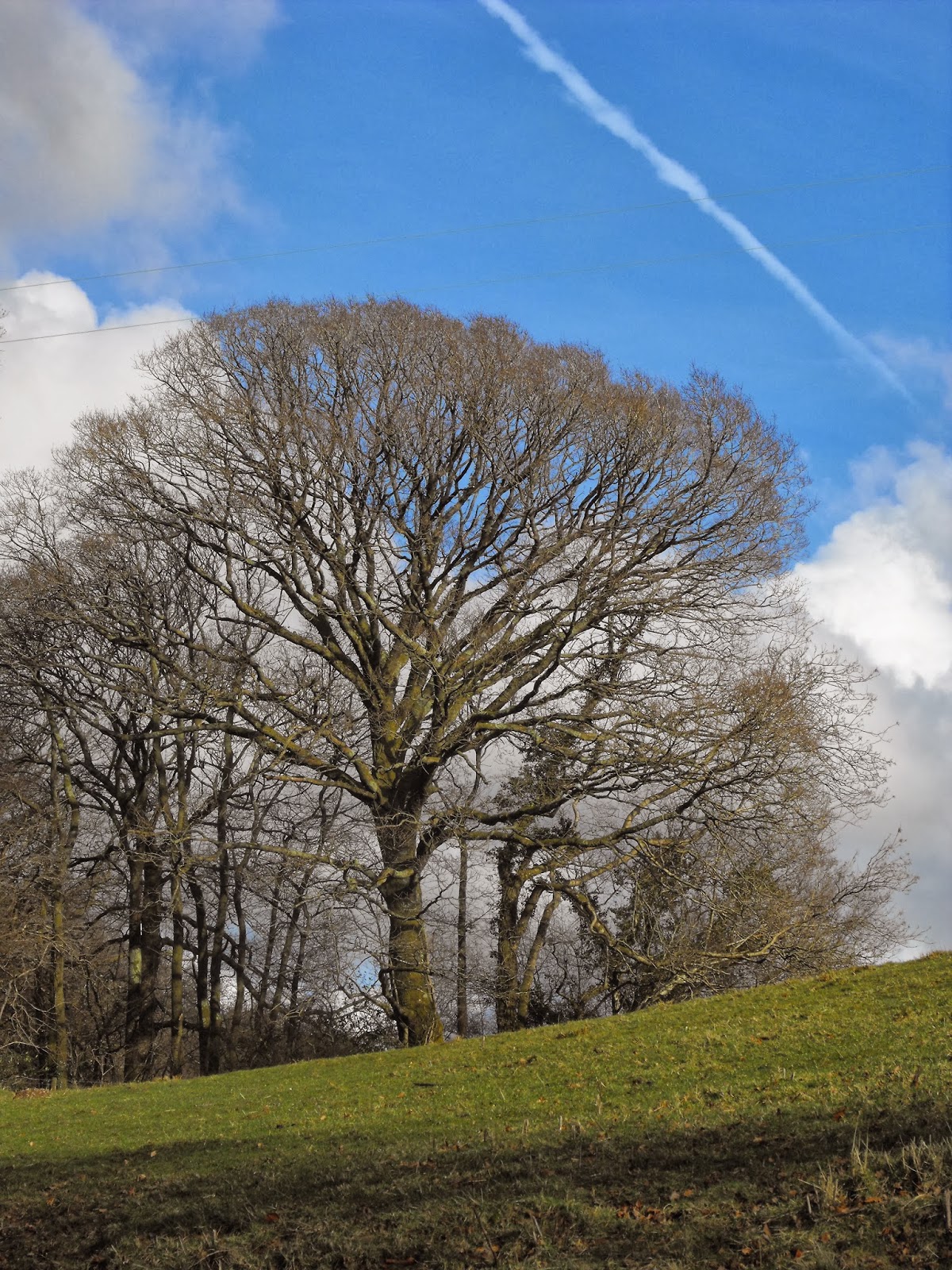
 As I said, it was DRY . . . rather than sunny.  Yet this photo of the tree shapes has tiny highlights - only of shades of green - which enhance rather than underline the drabness of a February afternoon.


 And again - this is a tree I would scarcely notice in summertime.


 This splendid chap is beside the lane leading up to Llanfynydd.


Recent storm damage to one of the riverside trees.  There are a lot of beeches here and also a fair bit of disease in the trees.


In falling, it side-swiped this tree too.


The lane ahead, and another winter tree.  I took the little lane by Fynnonau leading me up past Eisteddfa.  Eisteddfa means, from what I recall, "meeting place" and may have been associated with St Egwad, back in the early days of Celtic Christianity.   Ffynnonau means "springs" (as in source of). 

Snowdrops crowd together on a bank top.

LAMBS!  There were quite a few of them in this field, and for once, some COLOUR - even though green is the way to go . . .


Back to virtual monochrome again for this view across the valley.  Section A's in the front field from the same stud where we bought our little palomino Merlin 25 years ago now.  He would be 26 this year, if he is still around.


I have to say, by this point on my walk I was struggling a bit.  Just not really in walking mode, and my lungs were starting to complain (my fault for not drinking enough water I suspect).  Anyway, I phoned my husband to come and rescue me, and noticed this Primrose just as he arrived. 

This was where I was heading before I got tired. To the left of the picture is Wern.  Straight ahead are the flat fertile fields of the Towy Valley.  Llanegwad village may just be visible on the right, and the A40 is out of sight beyond the fields.  The green of the grass suggests it is just starting to grow again, and whilst we had a chillier day today and a downpour of hailstones this afternoon (just as I was outside cleaning the bay windows), spring seems a step closer.

Monday, 24 February 2014

A walk up the valley


After FINALLY tackling some long-overdue housework this morning, I took advantage of the sunshine and had a walk up the valley, surprising a bevy of sunbathers as I did so . . .


Here they were before they noticed me.


The two greys are mother and daughter.


I was trying to capture some beautiful tree shapes again.  Here is one earlier in the walk.  I had just stopped to take a photo and then watched a pair of Long Tailed Tits playfully following one another along the hedgerow.

Nettle Soup anyone?  These are the first of this year's crop, in a sheltered hedge bottom.

Nother first sighting - Dog's Mercury, a sign of ancient woodland.

Foxglove leaves are putting on some growth now.


Rafts of Saxifraga oppositifolia in the wet alder-carr woodland.


There's an old trackway runs through these trees (you might just see the bank edging it on the stretch of deciduous woodland).  It used to go to an old cottage, whose name eludes me, but all that is left of the place now is half a brick.  I wrote a poem about it once.


Leaves of Lords and Ladies enjoying the sunshine.


Beside my neighbour's farm, an ancient Medieval holloway which takes you into the next parish.  I used to ride up here sometimes, and more recently, walk - either from this end going up and in a circle, or sometimes the other loop.  It has a real feeling linking you to the past, and the landscape looks totally different from this ancient trackway.


At Nant Gwilw, this huge old oak tree must be 600 years old or even more.  It is vast around the trunk.

The really spooky Nant Gwilw which has SUCH an atmosphere to it.  I think I have told its story before, but will have to try and find it in my "back issues".


Another winter-bare tree - an oak  - which has seen many a winter.


Lastly, found in a charity shop on my recent travels.  C. 1980s Laura Ashley hexagons.  £2.50.

And from the same household I presume, some 10 or so blocks, beautifully pieced, along with material for more . . .


Just £1.50 for all these.  it must have been my lucky day!

Had I not paid full whack for them at Christmas, I could have got a big cutting mat and an Omnigrid too (£4.99 each).  Ah well . . . someone else will benefit.

Saturday, 22 February 2014

Our house, Gwyddno Garanhir and the sunken land of Cantre'r Gwaelod

The sunken land of Cantre'r Gwaelod  . . . .


These 5,000-year-old trees have emerged on a beach in Mid Wales after peat was washed away during the recent storms


 HERE is a link to an article about how the recent storms have uncovered more of the Bronze Age forests off the Cardiganshire coast near Borth.


The oak and yew stumps were once part of a forest that covered the whole area before it turned into a peat bog and was eventually overwhelmed by water

Scientists knew the forest was there as stumps could sometimes be seen at low tide, but these new remains have appeared further north than the previous sightings
Amazing photographs, and many thanks to the Daily Mail online, from whence I have copied them.

The tale of Cantre'r Gwaelod (the "Lower Hundred") is an interesting and ancient one, possibly far older than it has been given credit for, given that this is a sunken Bronze Age Forest (e.g. around 5,000 years ago this sank beneath the waves), and indeed, the legend may well chronicle the rising sea levels following the final melting from the Ice Age which finally ended about 6,000 years ago.  Cantrer Gwaelod is the Welsh equivalent of Cornwall's Lyonesse going beneath the waves - our equivalent of Atlantis.

The first written record of this legend appeared in The Black Book of Carmarthen, which dates back to about 1250 and this stretch of the coastline (between Bardsey Island and Cardigan - basically, beneath what is now Cardigan Bay) was known as Maes Gwyddno (the Plain of Gwyddno). It extended some 20 miles from the present coastline.  It was apparently low-lieing land which was protected from the sea by a series of sluice gates and a dyke known as St Patrick's Causeway.  Its capital was Caer Gwyddno (the Fort of Gwyddno).  In the Black Book of Carmarthen legend, it is a well-maiden, Mererid, who neglects her duties and because of this the well overflows and floods the land.  In another version of the legend (the one I am familiar with), it is one of the two Princes of the realm (Seithenyn), well known for his drunken ways, who neglected to shut the floodgates and thus the land was inundated by the sea.  A very similar tale is told of low-lying land higher up in Wales, Llys Helig (from what I recall "Llys" is always connected with a - high status - court).  They both have the same link of the church bells being heard tolling when danger threatens. HERE  is a link to the Widipedia page on the subject.

 This ancient forest has been known about and monitored in the past, and storms have removed its preserving (anaerobic) bed of peat, but never to this level and this has now extended further north towards Llys Helig?.  Species of trees include Yew, Oak, and Pine and the recent discoveries, near to Ynyslas, were Oak and Pine trees.  More excitingly, stretches of a wattle trackway have also been discovered and will be subject to dating tests to establish in which period it was built.  HERE  is a link to the Daily Mail article with further photographs. HERE  is the BBC's take on this Legend.

There is some doubt as to whether Gwyddno Garanhir actually existed - or at least, in the land of Cantre'r Gwaelod.  Historians have placed him in Merionethshire.  Be that as it may, the basket of Gwyddno Garanhir was one of the Thirteen Treasures of the Island of Britain .  This is a variation on the Christian loaves and fishes, as food for one man would be placed in the hamper, yet when it was opened, it was found to contain enough food for 100 men.

Anyway, after his productive lands (one acre would produce the same food as 4 acres would elsewhere in the Welsh kingdoms) were beneath the sea, Gwyddno Garanhir had to seek his fortune elsewhere in the less productive areas of Wales.  His son, Elffin ap Gwyddno, was the foster father to Taliesin, who became one of the most famous of Welsh poets, who flourished in the 6th century.  His name, translated from the Welsh, means "shining brow". 

Now what, you may be asking, is the connection with our house?  Well, when we first moved here, and our children went to Mother and Toddler Group in Brechfa, the Vicar, now Canon Patrick Thomas wrote a paragraph in the parish magazine, something along the lines of welcoming us to the parish, and how amazed he was that we had come to live at Ynyswen, as the Lloyd family (I think it was) were descendents of Gwyddno Garanhir, of ancient days.  Gwyddno Garanhir's name may be translated thus: Gwyddno Long-Shanks;  Crane-Legs or, Tall-Crane.  Anyone who knows us by name, will instantly make the connection!  Perhaps we had returned home?!

Anyway, I am hoping that my husband and I will get a chance to visit Borth at low tide in the next week or so, weather permitting, and get some photos to share with you.


Thursday, 20 February 2014

Off in search of spring . . .


Today's post is over on my other blog, Dust on the Nettles, about Edward Thomas.    I hope you will visit.

Meanwhile, normal service should be resumed here shortly.