
Not a real stone circle but a Gorsedd one to commemorate the Eistedfodd held here in 1993. One is erected at every town hosting the Eistedfodd.

This is St Mary's Church in Builth. This was originally built in the 13th C, the tower dates from the 14th C and it was largely rebuilt in 1875. In the porch is an effigy of John Lloyd, "esquire to the body of Elizabeth I". He lived not too far from us, but the house he lived in was destroyed long ago and no-one knows where it was now. However, a late Anglo-Saxon stone was built into his house, and later incorporated in another before being discovered and is now a Museum piece (as mentioned in an earlier post).

This is the Alpha Chapel, called this as it was the first Meeting House (Presbytarian) set up by Howell Harris in 1747. Since then it has been rebuilt twice and this photo shows how it was rebuilt in 1903.

The War Memorial at the entrance to the Groe car park. I should have taken one on the other side to show the many wreaths laid in respect.
Another from-the-back picture of one of several memorial benches, this one in respect of the 2nd World War. I think the Round Table are responsible for these.


Our daily walk through the Groe, which is the park area beside the river, has been rather brisk of late - quite a wind is channelled along beside the river. We were lucky with this morning's walk as not only did it stay dry, but the sun came out. I had a quick look at the information board by the bridge over the River Irfon, and it mentioned animals being put to pasture there in previous centuries, and also tanning procedures being carried out there - must have been very smelly then (cattle skins rather than ladies wishing to be browner!!)

The Canada Geese are still here and one of them was chasing off his rivals this morning. It must be breeding time. Indeed here at home we have a Robin building her nest in the grey cupboard where Keith keeps his bottles and tins of wood stains. It was exactly this cupboard where another Robin built a nest at our old home!

Above and below: the same artist who has done other work around the town, has brought to life the story of Llewelyn ap Gruffydd, born in 1223 and the last Prince of Wales, who became a wanted man after he rebelled against the English King Edward (responsible for many defensive castles around Wales, but especially in the North), which was the stronghold of these troublesome Welsh princes who were able to carry out guerrilla attacks from their mountain hideaways. When those very English castles in Wales were attacked by Llewelyn, Edward vowed revenge. Llewelyn left his brother Dafydd in charge whilst he gathered an army and set off for Mid-Wales to attack Edward on a different front.
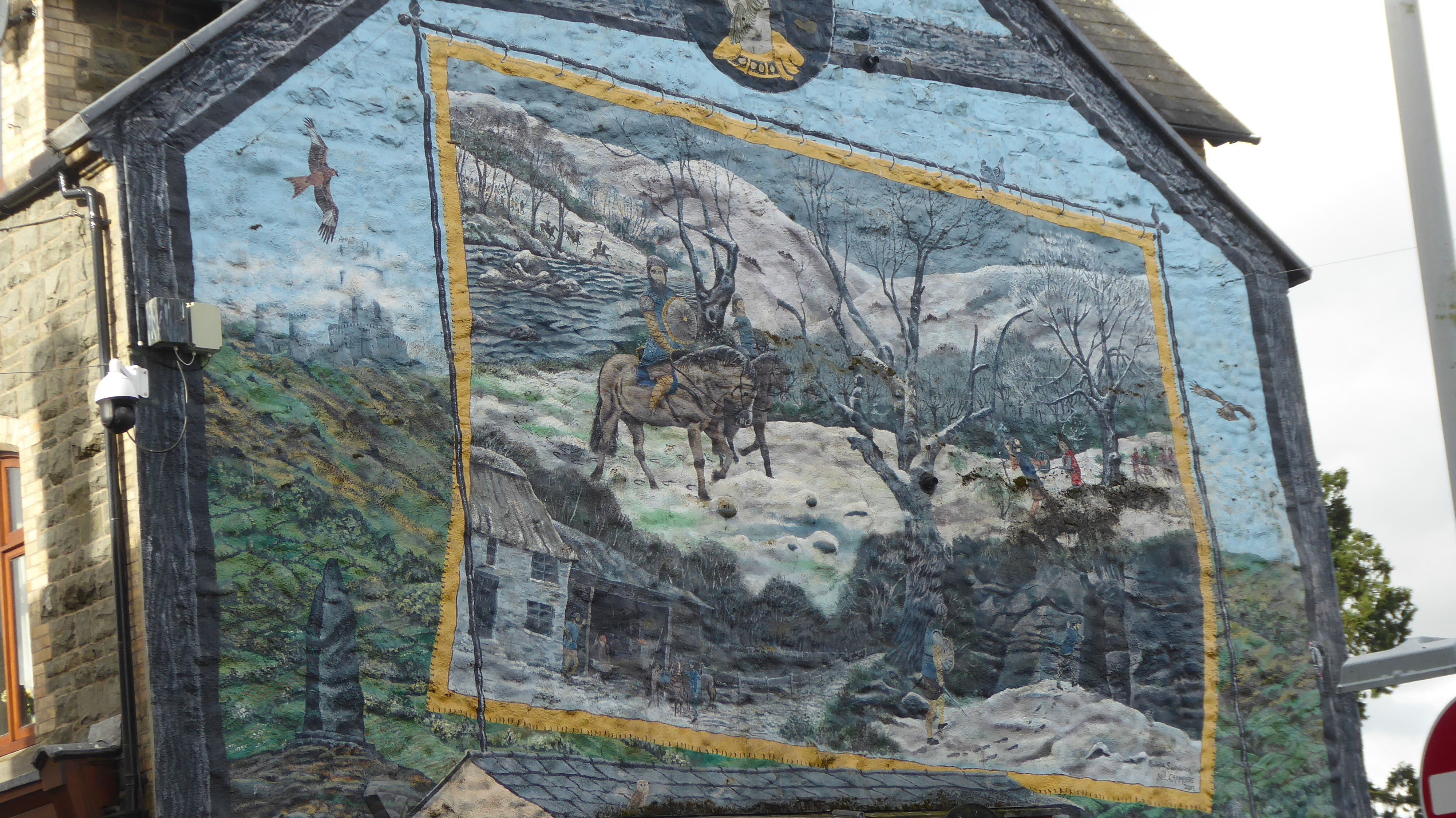
It was December in 1282 when thing came to a head. Legend has it that Llewelyn took shelter in a cave up on Aberedw (the hill we can see from here) whilst gathering his forces. It is also said that he asked a local blacksmith to shoe his horse with the shoes on backwards, so as to confuse his enemies.
The following day the battle took place at Cilmeri, a village a couple of miles from Builth, beside the River Irfon. Llewellyn had gone into Builth in a last-ditch attempt to rally local supporters. Upon hearing that the battle had gone badly as the English archers attacked the flank of the Welsh and scattered them with their larger force of Heavy Cavalry, Llewelyn and a small loyal band of his men sped in support. However, they were attacked as they reached the edge of the battle and he was killed but his identity was not realized.
The following morning when his body was identified, his head was cut off and washed in a nearby well and then sent to London where it was paraded through the streets and then put on a pole at the Tower of London, where it stayed for 15 years.
Today there is a huge stone which is a memorial to him at Cilmeri (I will visit next week and get photos). There are steps down to a cover over the very well where his head was washed. With his death so ended Welsh resistance against the English throne. Please go to this link where I gained much of the information written above (plagiarism!!) but gives a lot more detail and is very interesting reading as it gives much more background detail to Llewellyn, Prince of Gwynedd.
If you are interested and would like to learn more about this period in history in Wales, I can recommend Edith Parageter's The Brothers Gwynedd quartet of novels. (She also wrote as Ellis Peters, famous for the Brother Cadfael novels).
A couple more photo from up the town - on a shop which is still shut (of course) by the same artist I would assume - and also responsible for the Welsh dragon I showed a few posts ago.


