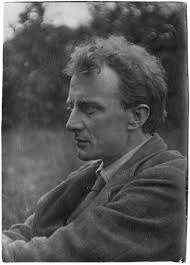
. . . and I'm afraid it is an unrequited passion and always will be . . . for the darling man is dead.
The object of my passion? Dymock - or war - poet Edward Thomas. I read his prose, his poetry, and wish that I could have met this man for like his wife Helen and their friend Eleanor Farjeon, I would have worshipped him. His thoughts, his sensitivity, his eloquence, his empathy with the natural world and his knowledge of it, his descriptions - does such a man exist now? I doubt it. Let me share one short piece with you and see if you aren't half in love with him too . . .
THE BROOK The brook rises in clear, grey, trembling basin at the foot of a chalk hill, among flowers of lotus and thyme and eyebright and rest-harrow. Here the stone curlew drinks, and above is the gently rounded encampment, ancient, and yet still young compared with the dusky spring which has something gnomish and earthy about it, though ti takes the sun. it drops in thin, bright links over the chalk, and then for a time loses its way in playing with cresses and marsh marigolds,spreading out so finely that hardly will the ladybird drown that falls therein - falling at length in cascade from one dead leaf to another down a hedge bank. Below, it nourishes the first forget-me-nots, by a gateway where it slips across the lane, and is dew-fed by the vetches and clovers that swaddle the posts of the gate. Now it is unheard and unseen in the darkness underneath dog's mercury leaves until it has gained its first treble voice as, pausing by an interrupting branch it fills a hollow and pours over in icy fingers to the ditch beneath. Here it has cuckoo-flowers and creeping jenny and butterbur to feed; thrushes drink of it, beetles dart across it like scullers that dream now and then upon their sculls. It learns now to sway the cress, to bow the brooklime, to brighten the sides of the minnows, the fledgeling of the robin that falls into it dies. It floats the catkin down and out of it rises the azure dragon-fly. Sometimes it muffles its going in moss, but in a little while it gushes through drains and falls and falls with a now unceasing noise in a land where all the hollows are full of apple trees, rough grey with dewy clover, and through all the hollows winds the brook, dappled by blossom, leaned over by the bee-cradling, sleepy, meadow cranesbill flower; in its green bed the water-voles wear their submerged pathways.
There is more. It appears in "One Green Field" (ISBN 978-0-141-19091-4).
Sadly Edward Thomas was killed by blast on the date of my birth, but in 1917. There was not a mark on him - it was as if he had passed in his sleep. Thank God for that much . . .
 Oh, and just a footnote. I have computer problems (it won't load my photos) so if I go quiet for a couple of days, it is because the computer is having keyhole surgery . . .
