Wednesday, 19 October 2011

I love Museums - visit to Red House Museum, Christchurch

I have always loved Museums. When I was growing up I used to visit the Tudor House Museum in Southampton almost every week. I can still remember the stuffed Dachshund . . . This particular museum has been beautifully restored now, and is totally different to the room layout I remember from the 1960s.

My husband also loves Museums, and we make a point of visiting any in the vicinity of where we have journeyed. A friend had reminded me how good the Red House Museum at Christchurch was, and so we spent a very pleasant morning in the town, exploring the Museum and the Abbey. I hope you will enjoy the Museum as we did.


The workhouse is remembered in this plaque. I don't doubt it contained many unhappy families and orphans in its time, folk "on the parish" largely through bad fortune. At all events, the old Workhouse now houses the Red House Museum.


View across one of the garden areas at the back.
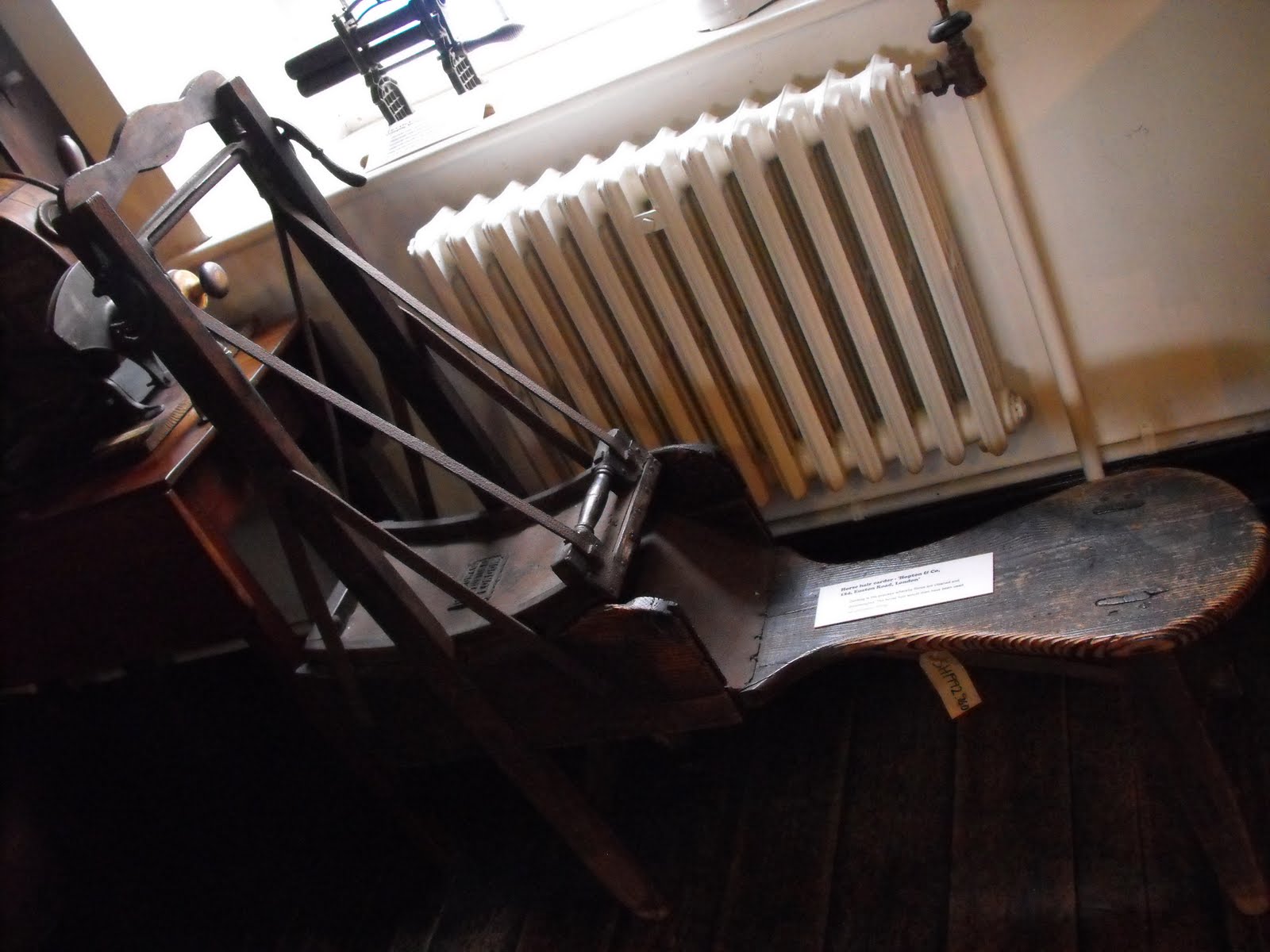
Above and below. In an age when horses were the main form of transport and had relatively short working lives, this machine made use of the horsehair "harvested" at the knackermans . . .


Various earthenware steens, drainers and Dorset Owls from the Verwood pottery. This round jug with "lugs" was used by farm labourers to take cider or cold tea to the fields with them at harvest time.

Wonderfully set out inglenook fireplace with all sorts of goodies from the past.

A lovely stack of steens (or pancheons as some people know them).

Grimwade's quick cooker for stews or puddings . . .

Above and below. An early "washing machine". I bet washing day was NOT a popular workday in the Convent . . .


This display was to show the importance of home-sewing in the past, particularly when there were few ready-made dresses available.

All manner of lamps too, including a little rush light holder on the right, just in the picture.

I was keen to photograph these as they are relevent to my family history, as my g. g. grandfather was a coachman, who drove the Exeter coach in Devon. These would have been familiar to him. Above coachman's tools; below spare adjustable horseshoe.


Above and below, several of the beautiful period dresses on display.

Isn't this shawl gorgeous? I saw one very like in an antiques shop in town with £85 or so on it.

A selection of bags, fans and hats.

Medieval horse shoes and ox shoes.

Tuesday, 18 October 2011

Playing catch up

Scarlet wilding apples from an apple core discarded 30 or more years before . . .


Well, much as I wanted to, I didn't go to my spinning/weaving group as I was so behind here so I had a catch-up day, and as I have pretty well ticked everything on the immediate list, so I am very pleased with myself. The day began with a walk up the valley - about 1 1/2 miles in all - I'd have gone further but I had a long mental list of jobs for the day.

I started by making crab apple jelly from the 9 lbs or so I had left of the fruit I picked in the New Forest when we were there recently. I had cut the fruit up and cooked it a couple of days ago and let it drip through the jelly bag overnight. Then it had sat on the stove in a pan with a lid on, reminding me it needed doing. I got about 4 1/2 lbs yield, which doesn't seem much from such a lot of fruit and sugar, but crab apples aren't juicy, although they make divine jelly. Whilst I was washing and sterilizing the bottles for the jam, I took another box of bottles I'd been given and soaked the labels off and they are dried and stored away for the next session.


Then, as I drank a mid-morning cup of tea, I peeled and salted the 2nd half of the pickling onions and have them waiting overnight before I wash them off tomorrow and bottle them using the spiced vinegar I made this afternoon. I think I will probably buy some more onions and bottle them up, so I have a full year's supply (I'm the only one who eats them).

Next it was the wine which needed sorting out. I searched for demi-johns first, but then realized I had recycled half a dozen last summer when we were having a clear out and I thought I would be cutting right back on wine-making as I haven't done much in recent years. Wrong move! However, during my search I found a brand new but dusty 5 gallon plastic fermentation bin (you just fit an airlock) so took that indoors to be thoroughly washed and sterilized. Into that was carefully racked and decanted 3 gallons of gooseberry wine, which is still working but sat on lees which is not a good thing.

Then of course I had to thoroughly clean and sterilize the three demijohns, as I had two further demijohns of Damson wine to rack. So I did that, and washed the other two d-j's. Then it was the turn of the crab apple wine in the wine bucket, which had to have the fruit removed and then be poured through a straining bag to remove all the pips and bits. That is now mixed with sugar and yeast and will be soon be bubbling away. I feel like an alchemist when I make wine! All that took me 2 hours, which was a lot longer than I anticipated.

I made a batch of spiced vinegar for the picked onions, and as it cooled, I put tonight's chicken in the oven to start roasting, and went outside to put the 11 white Geraniums I'd had in a border to overwinter inside (down in mum's). The needed to come in before the first frost.

Then I peeled spuds for the roast, and prepared the vegetables and Yorkshire pudding mix, peeled and cooked up 8 apples for a crumble, made the crumble mix, and cooked it.

So that's crab apple jelly done; pickled onions done; wine done; several lots of washing up done; roast dinner and apple crumble done; Geraniums potted done. I think I have earned a beer tonight!

Wednesday, 12 October 2011

Sturminster Newton Mill and an old recipe sheet


When we lived in Dorset, we used to visit Sturminster Newton every Saturday and Monday for the auctions and the Market. We always bought our cheese on the market and then visited the Mill when we needed bread flour, which was stone-ground and wonderful stuff. After stopping at Fiddleford Manor/Mill, we drove the mile or two up the road and stopped at the Mill, for old times' sake. Sadly, it was not one of its open days. (It is now run by the National Trust . . .) Not too disappointing, as we had been around the mill many times and didn't need bread flour. I hope these few photos give you an idea of how it looks, and how serene the spot on the river Stour. Thomas Hardy and his young wife Emma lived a few hundred yards downstream from the Mill and would have known it well. I dare say they walked to Fiddleford too, as there is (I have only NOW found out) a beautiful walk along the river between the two. Amongst my loose recipe sheets, I found an egg yolk yellow sheet with a picture of the Mill and "Sturminster Newton Mill Recipes" stamped on the top. So I shall add a couple of recipes at the bottom of this posting.

We finished our little outing by parking in the market place at Stur (what the locals call the town and we always have too). Sadly, it is much altered from our day, and the big cattle market was finally closed in 1998 and is now covered over with housing and everywhere much-altered. The buildings where old Dicky Burden used to hold his auctions, and quickly sell the best lots to a spot by the door (!) (e.g. himself!) are no longer there. We have many happy memories of days spent there, seeing who bought what (and where it ended up next at auction, often being bid up by the new buyer lurking at the back of the crowd!) and for how much. We made quite a few purchases there, many of them very good bargains. Nothing went unsold - even if he had to drop the starting price to just 10 pence (this was 25 years ago), he would sell it, even if it had to be for 11 pence!

Anyway, I had £10 burning a hole in my pocket when I went through the doors of Hansons, the BIG fabric and craft warehouse. I could have spent it a hundred times over but in the end came out with a handful of fat quarters with which to make pretty borders for pillowcases (some as presents). Money well spent.


STURMINSTER NEWTON MILL RECIPES

Freezer Cakes

1 oz fresh yeast or 1/2 oz dried yeast
1 tsp baking powder
1 lb wholemeal Stour Flour
6 oz sugar
2 eggs
1/4 pin milk
8 oz margarine
1 1/2 lbs mixed fruit

Beat together yeast, eggs, baking powder and milk in a large bowl. Rub fat into Stour flour and stir into yeast mixture. Stir in sugar and fruit and mix thoroughly. Cover and stand overnight. Divide mixture between 2 x 1lb loaf tins (greased and lined). Bake at gas no. 2 (300 deg. F, 150 deg. C) for 1 1/2 - 2 hours. Can be frozen for up to 3 months.

DORSET APPLE CAKE

Well, I couldn't leave this one out!

6 oz wholemeal flour
3 oz demerara sugar
2 medium eggs
pinch of salt
3 oz hard margarine

Sett oven at mark 5 gas (375 deg. F or 190 deg. C), middle shelf. Greaase a 7 inch oblong dish or tin. Rub fat and flour together with the pinch of salt. Add the sugar, and the two eggs beaten. Add enough apples (sliced thinly) according to your taste. A nice sharp Bramley cooking apple is best. Put into your greased dish and sprinkle the top with a little more demerara sugar and bake for 3/4 hour. Lovely with a nice drop of cream . . .

GINGER CAKE

2 tablespoons milk
6 oz soft margarine
6 oz soft brownsugar
3 large eggs
6 oz wholemeal flour
1 1/2 tsp baking powder
2 level tsp ground ginger

Set oven at mark 4 gas (350 deg. F or 180 deg. C)

Grease and line a 6 inch round cake tin. Put the margarine, brown sugar, eggs, flour, baking powder, ginger and 2 tblspns milk into bowl and, using a wooden spoon, mix the ingredients together until they are combined, then beat the mixture for about one minute to incorporate some air. Turn the mixture into the tin and bake for about 1 1/2 hours until it is well risen. When cool I ice it and place walnut halves on the top of the cake.

Tuesday, 11 October 2011

Fiddleford Manor

Fiddleford Manor, near Sturminster Newton, Dorset, which we visited whilst we were on holiday recently. We were delighted to find that it was an "open house" - no-one manning it, free entry (even better!) and we could wander at will, soaking up the wonderful atmosphere of this ancient property.

I couldn't resist the play of light and leaf colours through the uneven glass.

These information boards show you what it would have looked like.


.
A small window set in the gable wall of golden hamstone.

It had a stone-tiled roof. If you look at the thickness of these stone slabs, you will understand why such robust beams were needed inside the manor.

As you can see, there was a further wing which was demolished in earlier times, more's the pity. From the Mill mentioned in the Domesday book, it became a Manor House in Medieval and Tudor times, before becoming divided into accommodation for farm workers (who probably didn't appreciate its origins!

The beams in the roof are 600 years old. You can see that in the past a leaking roof has caused rain damage, but this has all been made good now.

Shapes within shapes. We have seen a similar design elsewhere this summer - I think it was at the beautiful Manor House at Tretower (see recent post).

This beautifully carved doorway shows it was a high-status building. You can just glimpse the plank and muntin wall behind it.

The verdant view through one of the windows.

A beautiful hamstone fireplace with herringbone interior.


Just a hint of the original wall paintings remains now, but you can imagine how it must have looked in its heyday.


You can see the water damage clearly on these beams . . .
My husband strolling past the end of the Manor House. As you can see, it is a "semi"!, and has been quite altered over the years. This side has been totally restored in recent years and is now under the control of English Heritage. It is part of the Medieval mill complex and just behind my back was the mill pond. It is one of the oldest buildings in Dorset, dating from the 14th century, and at one time was used to store hidden contraband . . .

Sunday, 9 October 2011

Thinking outside of the box . . .


Lidl had one of their periodic weekend sales of leftovers from the special offers they have each week. Whilst we didn't need cycling equipment, bike racks (yeesh, those bargers got in the way of searching), childrens' shoes/clothes, underwater cameras, pond set up equipment, we did snaffle up some bargains. The price range was 50p/£1/£3/£5/£10.

I was delighted to pick up two pairs of long (I can shorten 'em) white tab top curtains for £1 a pair yesterday - just what I needed for mum's flat. OH also bought a 3 LED light fitting to go over my counter for £1. Only today did we notice he had bought one that had a light bulb and cover missing. But hey, today they were 50p each and we bought two more to make up a complete one with spares! We also thought outside of the box a bit and bought 5 more lots of curtains (now 50p a pair) to use as curtain backings/linings or to back cushions etc. I have to go all the way to Swanea (a 50 mile round trip) if I want curtain fabric/linings etc now, so this was £2.50 well spent. We got two big chunks of good quality pond liner at 50p a time too, which my husband assures me he can find a use for - covering up his piles of maturing tree trunks I suspect! A box of wine glasses for our daughter in Swansea was the only indulgence, as they cost £3, but she asked us to look out for some and she will be happy that they are new (she struggles with the concept of 2nd hand, but she is young yet . . .)

This morning we had a wander round the car boot sale, which was just an echo of the size it was last week, when I had NEVER seen so many stalls or buyers on that site. Today I really struck lucky and my cosmic ordering machine delivered me a brand spanking new British-made (what a rarity in this day and age) old-fashioned design alarm clock for just 50p! I nearly bit the guy's hand off . . . It's a sort of clotted cream colour on the body, and is made in Towcester, which is where my mum's rellies came from, the lace-making ones.


Then we bought a cheap teapot, a solid brass big escutcheon thingey (OH will have a use for it I'm sure, he bought it), a beautiful little green glass dish for 50p that reminded me of a cobweb (photo to follow), and a solid oak (red-stained, ugh) candelabra for 50p which OH thinks he "may be able to do something with". My immediate thought was burn it, but what do I know? Oh, and for another 50p a book on Versailles. OH again. He only bought a book on Versailles a couple of weeks back, but this one is apparently "better" . . . I can see us having a good car boot sale next spring . . .


Anyway, housework calls, and so do the New Forest crab apples. I have some becoming wine, but need to do jelly with the red stripey ones. Right, up and at 'em . . .


I wish this was a computer which could waft you the exquisite smell of these wild apples cooking.


Now in the jelly bag overnight, and will be cooked up and potted tomorrow. The jelly bag, incidentally, IS scalded each time I use it, and sterilized with lemon juice too, but that does little to remove the blackberry and elderberry and damson stains . . .

Saturday, 8 October 2011

More green glass and a clever husband

I shall return to my travels on Monday, as weekends seem to be quiet in blog-land. Meanwhile, here are some pieces of green glass (which I collect) that I found at the car boot sale last weekend and which for just a pound or two apiece, came home with me.


Below is a beautiful Victorian mirror which we found a reasonable middle for. It had been lacking a mirror and gathering dust in one of the stables for several years whilst we mirror-hunted. Finally we found one that would do. It is actually oval (the angle of the photo makes it look far more circular than it is). Whilst the base is solid mahogany, the mirror is Walnut, but I am happy with it.


Below is the base my husband has been working on for weeks now. We bought the top half of this cupboard on stand many years ago at auction and just had it sat on the bottom half of an old wardrobe. Then my husband finally sorted out some bits of wood for this from his "collection" and so part of a desk, part of an old (burned) staircase, and parts from two old wardrobes (all solid oak) went into making this. Everything beautifully finished with hand-cut dovetail joints and perfectly fitted drawers. This flash photo doesn't do it justice as it makes the colour look totally different.

The photo below gives a better idea. My husband copied the design along the bottom from a piece of Carmarthen-made furniture we had already. The base cost him nothing but time.

Friday, 7 October 2011

On my mind . . .

Today I'm joining in with Rhonda Jean's Friday theme over on Down to Earth blog.

When we were in the New Forest recently, I made sure that I brought home several bags of wildings apples (these are apples which have grown from a pip from a discarded core, and some will later cross-pollinate with the natural crab apples). Apples from pips don't grow true - some trees which I grew from one of my apple trees here at home show two distinct fruits - one small and stripey and the other a large bland cooker which makes wonderful apple fluff. So it is with the trees on the Forest. This bright red apple looks sweet, but believe me, it wasn't as sweet as it looked like it should be! Such fruits make wonderful apple jelly though, and the wild crab apples make the best jelly (and wine) of all. I am making Wildings Apple Jelly this weekend.

I would like to preserve a lot more things by bottling, but there's the rub. It's the cost of acquiring all the preserving jars in the first place. I have basically priced the cost of a dozen 1000 ml glass preserving jars at £15 per 12 (that's a special price, they are normally offered at £20 per 12). That's a fairly big investment if you want to bottle up enough fruits to see you through the winter months and although they turn up at car boot sales, they don't turn up frequently enough! In America, some folk would have huge canning stores of anything up to 1,000 jars.

Which has made me think, we keep a reasonable store cupboard of tins and dried supplies, and do this by buying various things on offer or when we can afford it. We grow various fruit and vegetables in the garden and freeze/preserve them. We do what we can afford to do. And there's the rub - does that mean that being really self-reliant, that looking ahead to times of possible emergency when things fall apart for one reason or another, is purely the preserve of the better-heeled members of society, ones who already buy into this mindset and have stocked up? We as a family have already discovered that you need to fall back on such provisions when your personal economics make this necessary. Then the problem is to re-stock, when financially things are already tight. We have started small and gradually added to our stocks (and the glass jars!) but for some folk, even this is beyond them if they live very hand to mouth.

I could provide enough jam and chutney for ballast for the Titanic, but man does not live by jam alone! What do you do when you have a rotten summer and crop failures, or Blight on your spuds and Tomatoes, or the slugs get your beans time and time again and you have less home-grown produce than you need? On a tight budget, how do you cope with making up the shortfall of what you NEED?