Well, I didn't think I would be posting today to say that instead of getting better on the steroids and antibiotics, I have actually gotten WORSE and now have Pleurisy! I have spoken to my GP who didn't seem as concerned as I feel (!) and just said to up the steroids for another 3 days before gradually ending the course. That should do it . . . apparently. Let's hope so, as the pain in my back and behind my shoulder blades is rather unpleasant.
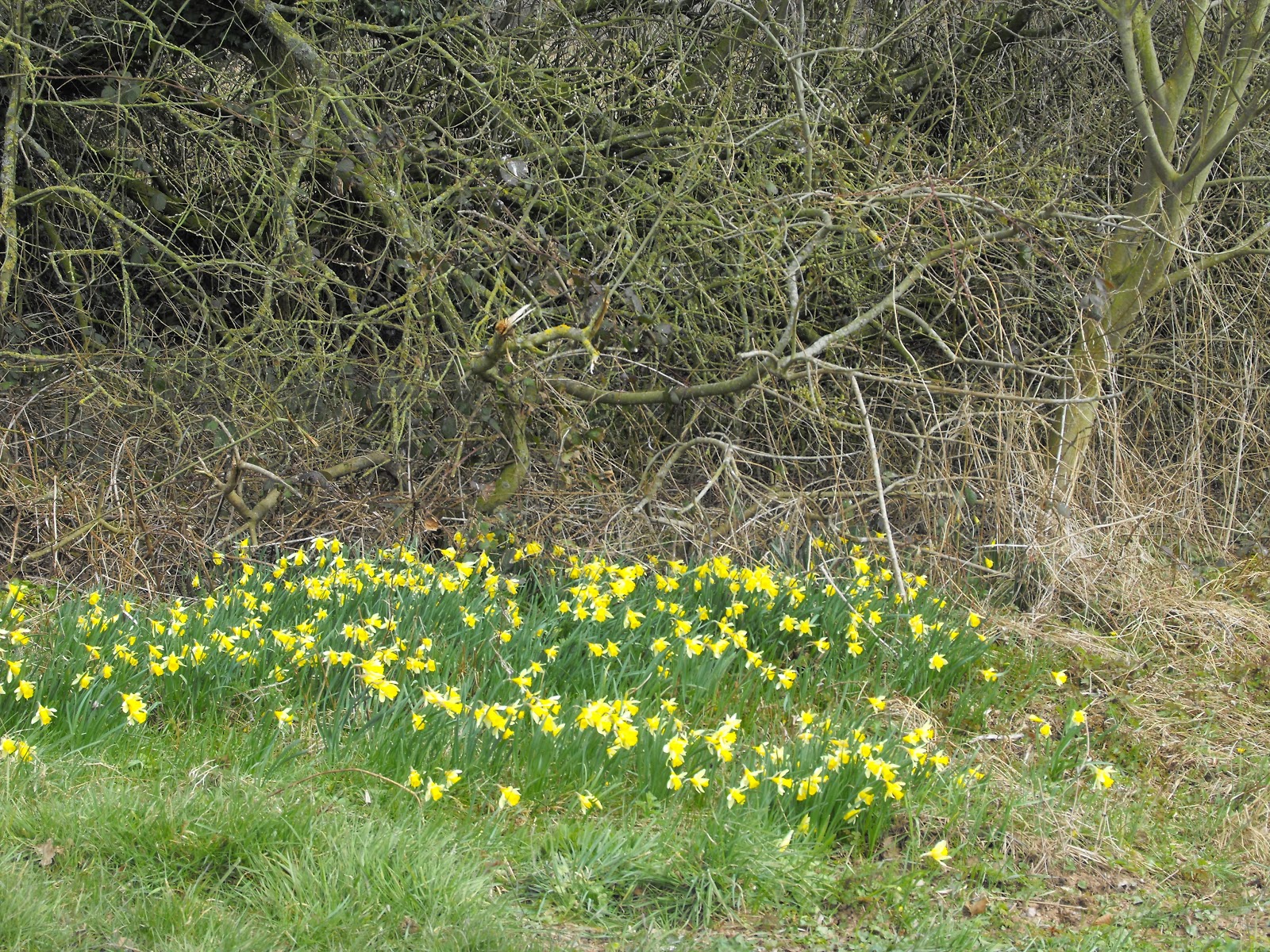
Anyway, I can manage to post a few photos. This top one is a patch of wild Daffodils near Kempley in Gloucestershire (right on the border with Herefordshire). This indiginous wild sort would have been the ones that Wordsworth wrote about - throw all thoughts of the gaunt modern King Alfreds from your mind please.
We went to Kempley Church first. Still too early for a big mass of daffodils I think, and without my friend J we didn't know the best places to look, but they will be there next year . . . Kempley Church was very quiet this time. No special atmosphere that it had last year.
I don't know what it is about such spots, but they truly seem to link in with the landscape. There are several places I could name (York Minster for one, parts of Avebury - nay, the entire area of Avebury, Gloucester Cathedral, and this church) where there seems to be a connectivity to . . . a divine feeling. That's the nearest I can come to describing it. At York it is like a pillar of pure energy flowing up through in one spot in - I think it's the Chapter House. This little church has it too, but it is more of an . . .earth energy . . . almost like a heart-beat. Strange. There's a little church on the Devon coast my friend went to, which had this feeling in such bucketfuls she nearly passed out . . . Explain it we can't, but it's there all the same.

Someone (on the Parish Council?) had decreed that it be limewashed in pale pink. I didn't like it. It might work in Suffolk, but not here. Bring back the white, say I.

I hope that you can read this or are able to enlarge it if you can't. Of the beautiful tympanum (guess who forgot a photo?) it says: 'The entrance to a Norman church was a focal point for symbolic imagery. The carved tympanum at St Mary's, between the arch and the lintel over the south door, depicts the Tree of Life, a symbol of Christ's salvation'. It dates to around 1130 and is similar to that at nearby Dymock church (which I visited, and also failed to take a photo as I was concentrating on the Dymock poets exhibition end of the church . . .) Smacked wrists!


And here is the other side, with paintings, looking back to the little escape doorway? at the end of the nave, leading into the tower. Probably defensive - there is one just like it in the 12th C church opposite Manorbier Castle in Pembrokeshire.

This LINK will tell you all about the wall paintings, which span two dates. The ones in the Chancel date from the 12th C and were painted directly onto wet plaster.
The Wheel of Life, above, in the Nave, dates from the 13th C, when all the frescos were painted using tempera (egg albumen mixed with pigments) on dry plaster. The Wheel of Life shows the ten Ages of Man.

One of the window apertures showing the painting of Heavenly Jerusalem.
How much we have lost over the Millennia, with the painting over of such frescos by the zealous Parliamentarians. What colour. What design. What craftsmanship. When I was younger, I used to poke fun at the old people who used to be interested in Church architecture and history. Now I am one of them!
