Showing posts with label St Afan's Church. Show all posts

Sunday, 15 February 2026

St Afan's Church, Llanafan Fawr


Back to church bothering again, having been inspired by the Vicar's tales of dastardly forbears on Friday night.  Plus - notice - it was DRY! with blue skies, but very cold first thing, and when I went out to the car, I had ice on the inside of the windows too which when I scraped it off, fell like snow!

I had a lovely cross country drive to this church (which is about 8 miles from home, much less as the crow flies).  The lanes were well marked, but the Romans had got there before me . . .


There are two stretches of Sarn Helen (which automatically says Romans to me, from my degree days).  One is North-South, from Aberconwy to Carmarthen, and nearer the coast, whilst the other stretch (East-West) is between Neath and Brecon.  This one is marked Roman Road on my map and comes up from Beaulah, pencil straight, and then on to Glandulas, and then it has a short stretch of what is footpath now, ending at Sarn Helen. (It will have come from the Roman camp at Llandovery). Beyond that there is a Roman Camp and stretch of Roman Road above Rhayader near St Harmon, and I will assume that it goes on to the Cambrian Mountains where there are lead and silver mines. I think this Sarn Helen is a hamlet of the name, close to the old road.


Inside the porch, the original stoup survived.  I am a clot for not looking this one up in my Corpus of Early Medieval Inscribed Stones etc (Vol. 1) BEFORE I went, as then I would have been aware of the porch containing several elements of the original much earlier church - the site harks back to the 6th/7th Centuries and St Afan is buried here to the S-E of the church.  To the right of the stoup is one of the earlier relics of the original church, a sort of leaf shaped pattern, though it is described as a cross with a herringbone pattern, and this design can be compared with decorated Irish slabs from Rathmichael and Ballyman, Co. Dublin.  The Irish influence is to be seen in churches across Mid-Wales from St Dogmael's Abbey (where there is a lovely collection of ECM's) and being celebrated by the Irish kings settling in Llangorse, where they had crannogs in the lake there (9th-10th C).  King Brychan, from whom Breconshire got its name, and who fathered a quite amazing number of children who all became Saints (of course!) in Wales and Cornwall.  But I digress . . .


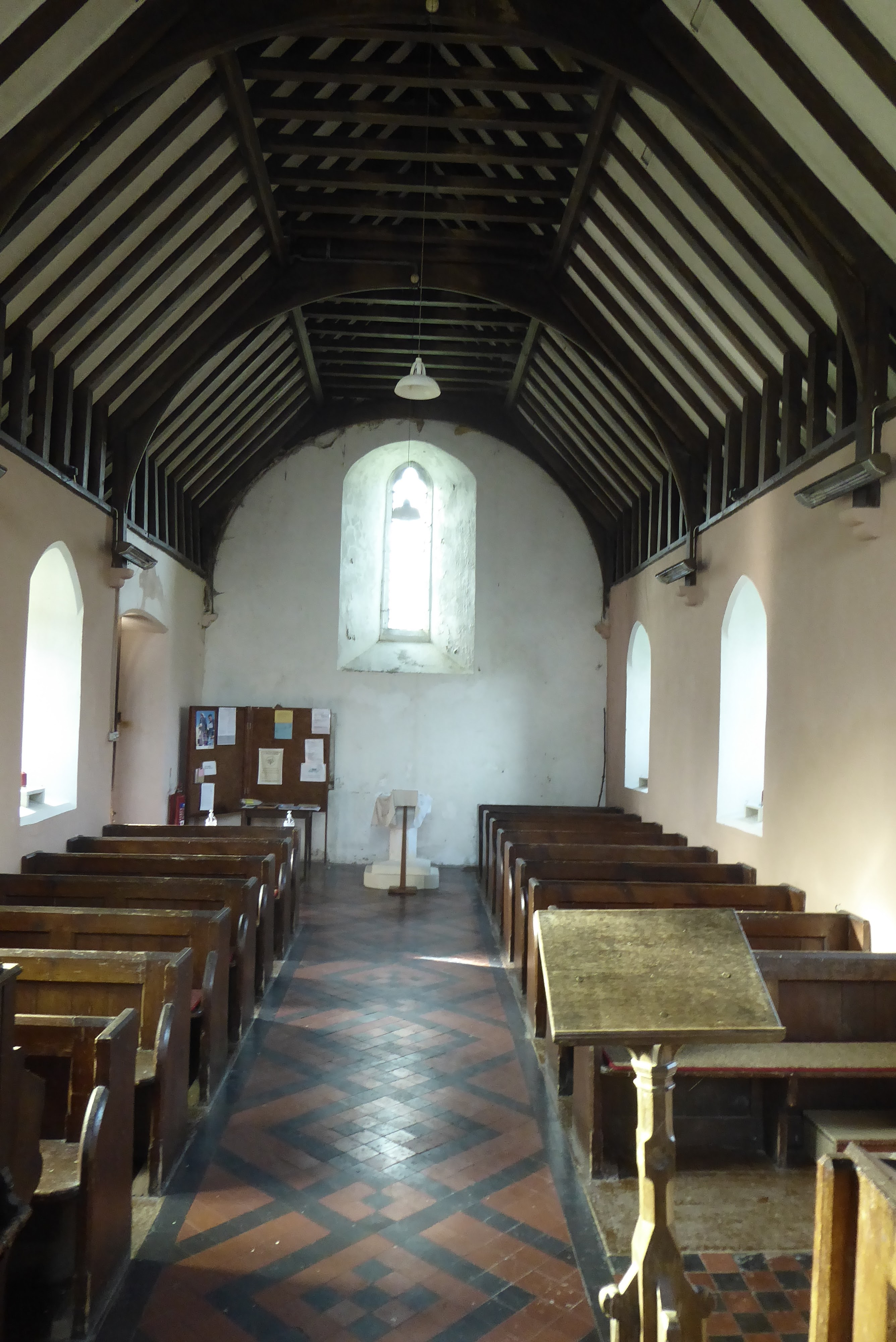
A plain and simple church internally, having been rebuilt (and smaller) in the 1880s.  The roots of the church go back to the 7th - 9th C.

There was a whopping organ, so they clearly put a great emphasis on hymn singing in this church, although the parish would appear to be fairly sparsely occupied.


A clearly Victorian crisply-worked font.


There were several Price memorials (it was a Thomas Price who was murdered).  I noted that their son died in Whitechapel, Middlesex and so perhaps they were not so parochial as many in the area.


A rather odd affair holding up the roof.  Not a clue as to the architectural term for this design.  Any idea, Billy Blue-Eyes?


Here's what put a smile on my face.  This may have been found embedded in the church wall during its restoration in 1887.  However, according to a chap called Rodger (surname) this stone was at Llaneleu.  I assume this is the Llaneleu near Talgarth - again, an Irish stronghold, and King Brychan, his 3 wives, and 24 sons and 24 daughters (said he was prolific) lived in Talgarth in the 5th C.  Again, there are design similarities with crosses in a group of grave slabs from the Dublin area.


Plus a 13th C font.  So glad it survived.  Presumably in use until Victorian times when they upgraded.


In memory of the fallen of the parish . . .


Sundial on the tower (built 1765 but with medieval foundations).  The plaque reads:  "This church was rebuilt at the expense of this parish AD 1814.  Thos. Prichard, Wm. Jones, Churchwardens, John Davies, Undertaker."

I scoured the churchyard for sign of the little and large headstones, of the murderer and his victim, and this was probably them, but they were rendered illegible by generous coverings of lichen.  


One of the more unusual tombstones in the churchyard. 


Across the road, and sadly now permanently closed, is the ancient building which was a popular pub until Covid.  It dates from 1472 and has a cruck frame internally.  HERE is an excellent link which tells you anything I omitted, and has some super photographs.


Enjoy your Sunday.

Friday, 2 December 2022

A plain little Welsh church - St Afan's, Llanfechan


I have passed this little church, set back from the A483 on what was probably the "old" road before they upgraded the A483, many times, but decided I would actually go and visit - it's not very far from here.  It dates back to the 13th or 14th C, although it was pretty well flattened and rebuilt in 1866.  I imagine this huge programme of rebuilding/renovating old churches in Victorian times was probably deemed necessary by their perilous state.


At first I thought it was locked, as the door wouldn't budge.  But a farmer moving sheep (this church has a farm to one side and farmyard in front of it) said it wouldn't be locked and jumped up the wall into the churchyard and put his shoulder mightily to the door which, though swelled with damp at the apex, finally gave into to his weight and allowed me through.


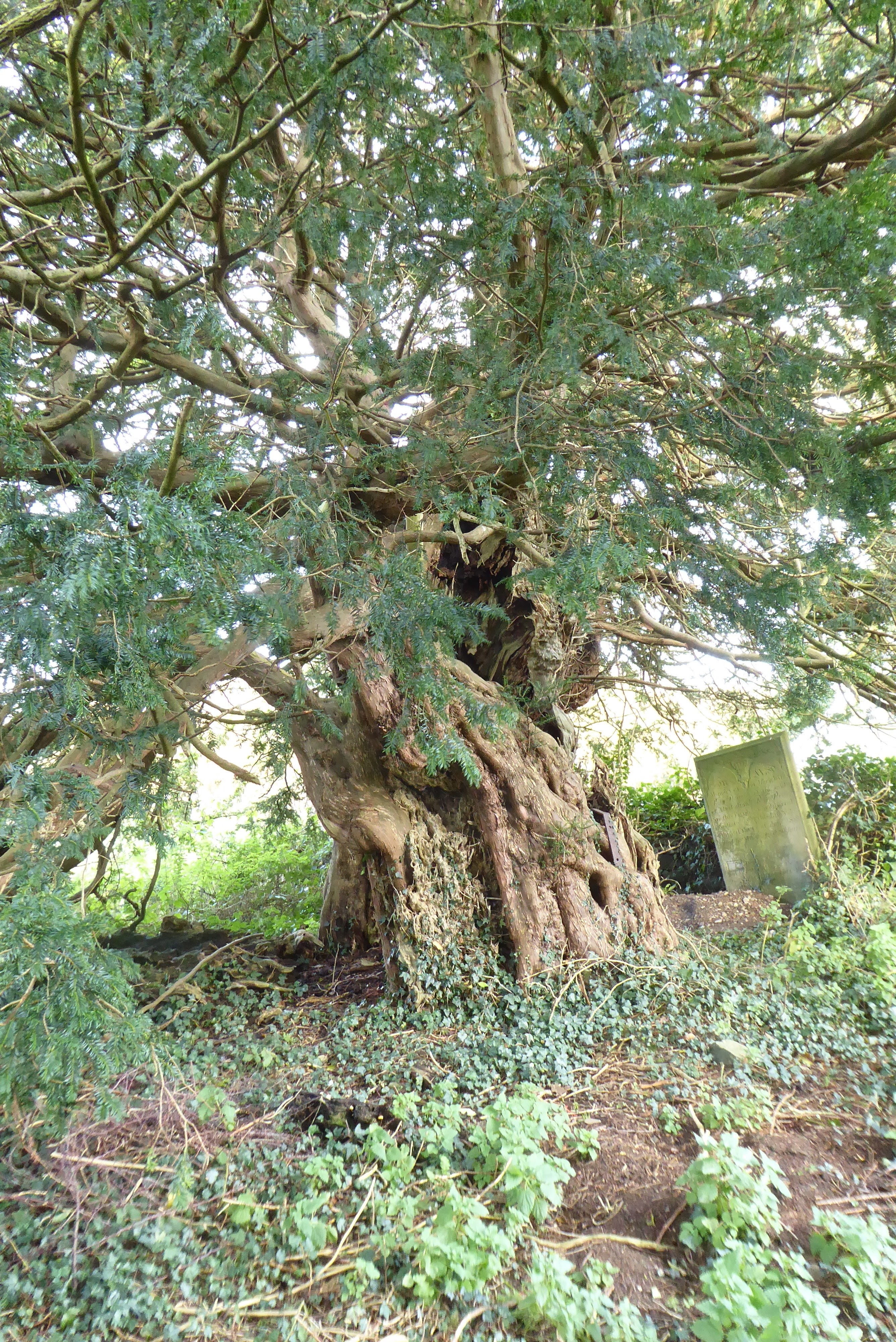
Judging by the age of this Yew tree, I would say that this was a very early Christian site.  The church is situated on a mound, though it's not that obvious in the photos and immediately beneath the church could well be the rubble from the earlier demolished church.  The churchyard is also circular, another pointer to antiquity.  This church, Llanafan Fechan (the lesser) and its neighbour Llanafan Fawr (the greater) a few miles Northwards, are dedicated to the Celtic Bishop Afan, who was usually named Afan Buallt, showing a close link with Builth Wells. He was a 5th or 6th C Bishop, so an early site indeed.


The view Northwards.


The 14th C font was very plain.


Indeed the church was plain and utalitarian. Its size echoed that of that Medieval church which had preceded it.  If there had been any obviously medieval parts, those were long gone.  The modernization was carried out by Charles Buckeridge, who also carried out the work at Llanlleonfel Church, the other side of Garth, which I also visited earlier in the year.

        What I missed, I now discover, is an early stone in the churchyard marked AVANIUS EPISCOPIS. Bishop Afan . . . So I will have to return and seek it out.

        Well, I have had to re-schedule the car repair as it became clear it wouldn't be done this morning (I got it down their for 8.45 too) but might be done before they shut this teatime.  Since leaving it there involved walking the 2 miles to and from home each way in freezing fog, and then again this afternoon even further across to Pam's to let her dog out for his ablutions whilst she was out for the afternoon, I thought it was better to leave it till I had a clear day.

        So, back to binding the lap quilt, now that I have buttoned everything together.  Heaven knows what tea is going to be - I had better look in the freezer for some inspiration.  

        The garage said we should be ok to drive to Crickhowell and back tomorrow, but I think we will have to cancel Llwyn Celyn as that adds another 30 miles to the journey.  Ah well, it will still be there next year.