Lace maker
‘Yon cottager, who weaves at her own door,Pillow and bobbins all her little store;Content though mean, and cheerful if not gay,Shuffling her threads about the livelong day,Just earns a scanty pittance, and at nightLies down secure, her heart and pocket light.’
So wrote William Cowper in the 18th century, when more than 10,000 people were involved in the industry.

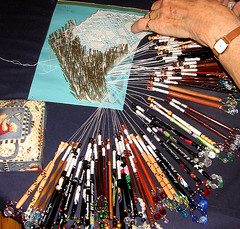
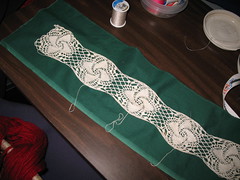
Whilst we were at Salisbury museum, I was fascinated by the display about Downton Lace which I had never heard of before. On my mum's side of the family, I come from generations and generations of Lace makers in Northamptonshire and to be honest, I would love to learn simple lace-making. Since I can't even manage to work out how to do the rest of the sock I am currently knitting, now I have turned the heel, it had better be Lace Making for Dummies . . . Perhaps I might be able to manage this eventually:

although this would be nice:

The Museum sold a fascinating little booklet about Downton Lace, and I would like to share some of its story with you.
Lace making was a common cottage industry up until the time when the craft was mechanized. Many people have heard of Honiton lace, Nottingham lace, Irish lace, and abroad, Brussels and Malta had famous lace-making industries.

In Britain, lace making is beginning to be mentioned as an export around 1560 when both bobbin and needle lace were popular. However, there is no written documentation of lace making in the Salisbury area (Downton is just a few miles below Salisbury) until the early 17th century. The finest laces commanded high prices. James I's wife Anne of Denmark treated herself to "
one piece of fine lawn to be a ruffe . . . 18 yeards of fine lace to shewe the ruffe at 6s a yearde £5. 8s. 0. (This was bought, however, from Basing in Hampshire), and from Winchester was "
4 yards of great bone lace at 9s a yard, 36s(hillings)." According to the great traveller Celia Fiennes (around 1697), Honiton bone lace was equal to that made in Flanders and Antwerp, although it didn't wash as well,
"which must be the fault of the thread".
In Salisbury itself, the Poor Laws of 1598 deemed that it was better for the poor to work and be independent rather than having to pay them parish relief, and overseers were encouraged to chivvy their paupers to find paid work for however small an amount and in a survey of 1625, 47 lace makers were listed. Half of this number were children and thirteen of these under 10 years of age. It was preferred that children be industrious and "be set to sewing, knitting, bonelace making, spinning of woollen or linen yarn, pin making, card making, spooling, button making or some other handiwork as soon as ever they be capable of instruction to learn the same." This was generally judged to be around 5 years of age and a little girl aged six, Rowland Rose, "works at bonelace with Widow Ashlye - to have weekly 3d)." Apprenticeships lasted some 7 or 8 years and the terms were very demanding, so much so that cases of apprentices running away and being brought to the quarter sessions. One apprenticed bonelace maker Ales Ireland apparently ran away 18 times (despite being given 'three good meals a day and having only once been corrected').
"She never cometh home but full of vermin in such state not fitting to come within any mans dores before she be cleansed and the time being dangerous she may not onely undoe us but also the town and country". One wonders what happened to Ales (Alice?) Ireland . . .

Parliamentary legislation had various effects on lacemaking and recorded numbers of lacemakers around 1698 show that there were 1081 in Salisbury; 336 in Downton; 500 in Blandford and 145 in Wincanton and area. This is the earliest recorded reference to Downton itself being a centre of lacemaking. Downton is not a large place, even today, and it would seem that a large percentage of cottagers there were involved in the industry. By mid-Victorian times, 30% of women described themselves as Lace Makers. A check on my 1881 census hs revealed that by then, only one woman, Ann Poulton (66) described her occupation as "Lace Maker", although there were three more in nearby Redlynch: Sophia Webb 61, Fanny Futcher 60, and Mary Herrington, 34.
Below: some Downton Lace patterns (double click to enlarge).

Attempts were made in the early years of the 20th century to revive the industry and to save information on lace making in the area, and patterns. It was noted that a group of lace makers from Redlynch had gone to Fonthill in answer to an advertisement for lace makers to make lace for the Queen. Indeed, Sophie Webb, mentioned above, was one of their number.
In 1903, lace making classes were started by a Mrs Plumptre in Downton (these would be the Council's night school classes) and about 2 dozen women and girls joined, but these classes were discontinued and instruction was contiued privately. Initially the Countess of Radnor (of Longford Castle, just outside of Salisbury by Britford and Bodenham) was involved in setting up the Downton Home Industries but she found it too arduous and Mrs Robinson took over the reins of the lace-making industry in 1909. Thus by the dedication of a few women was Downton lace making kept alive.
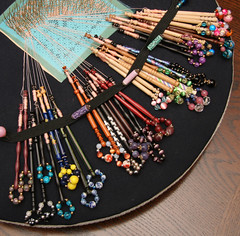
Apparently Downton bobbins were unique to the area, being of a slim shape tapering to a point and abut 3 - 3 1/2 inches long. The designs used on them included one "rather like a repeated Celtic cross in a square shield, in red and black alternately." Other motifs included "
twigs, branches, pot-plants, pheasants, fishes, hearts, suns, crosses and stars, and also a few snakes, ships and human figures." They were made from
"native species of wood such as box, plum, yew, may, spindle, cherry, apple, oak and occasionally from (imported) ebony" and were usually hand-whittled up until the 20th century.
The quality of the lace was dependent upon the quality of the thread, the finest being Nunns Thread, which was also apparently renowned in Castle Cary, over the Somerset border. various types of lace were made and the booklet states that: "
the Downton/Midlands Point Ground/Lille type was being made together with Bedfordshire, Torchon, Honiton and Russian Tape laces. Many of the subtle differences in working method which distinguish the downton patterns are in evidence amongst the samples collected (in the Museum). There was apparently always an ongoing desire to expand the repertoire, and some ofo the patterns were from as far afield as Russia, Sweden and Armenia, quite apart from the nearly-local (!) ones from Malmesbury, Wilts and Buckinghamshire. A total of more than 550 patterns have been recorded. Some of them were named after local people - Mrs Moody, Mrs Rolfe, Miss Gain, and local places - Romsey and Downton Daisy. Commemorative patterns were called Princess, Duchess and Princess Alexandra, whilst grumbling tummies were perhaps responsible for Buns and Butter, Orange, Lemon, Cheese-cutter, Eggs and Rasher, and Strawberry. There were also The Doll, The Rattle, Bat and Ball, Propellers, the River, Rabbits, owls, Horseshoe, The Shell, The Button, Ace of Clubs and Ace of Diamonds. There were even a Big and Little Idiot!!!
If you are in Salisbury or would like a special day out, do visit Salisbury Museum and make a point of looking up the Downton Lace display, where dozens of different samples are on display.