Thursday, 11 August 2016
Summer's end
A photo of Ghengis, who treats as a personal slave and always wants to sit on me whenever I want to just rest! He is a portly little chap, and Too Fat to reach any further down his body than this! I couldn't resist nabbing this photo as he was carrying out his ablutions this afternoon. He was really feral when he arrived, but it never fails to amaze me that once you gain an animal's confidence, and they learn to trust you, they become so loyal and loving. He is a Lap Cat - though he never jumps straight up onto the sofa or my lap, he comes up by the Scenic Route, crossing over the coffee table beside me, and I ALWAYS have to rescue my cup or glass as he would walk straight across it otherwise!
A very late attempt number two at runner beans and dwarf French beans. The slugs had the rest. In spring, I had stupidly planted a small amount of seedlings - "just enough for me". (I normally plant up a whole pack of seeds, at 4 to a pole. Well, the slugs obviously thought they were "just enough for them" and nobbled the lot. These seem luckier and have been cossetted and fed within an inch of their lives. I have my fingers crossed that they will produce some beans before the first frost.
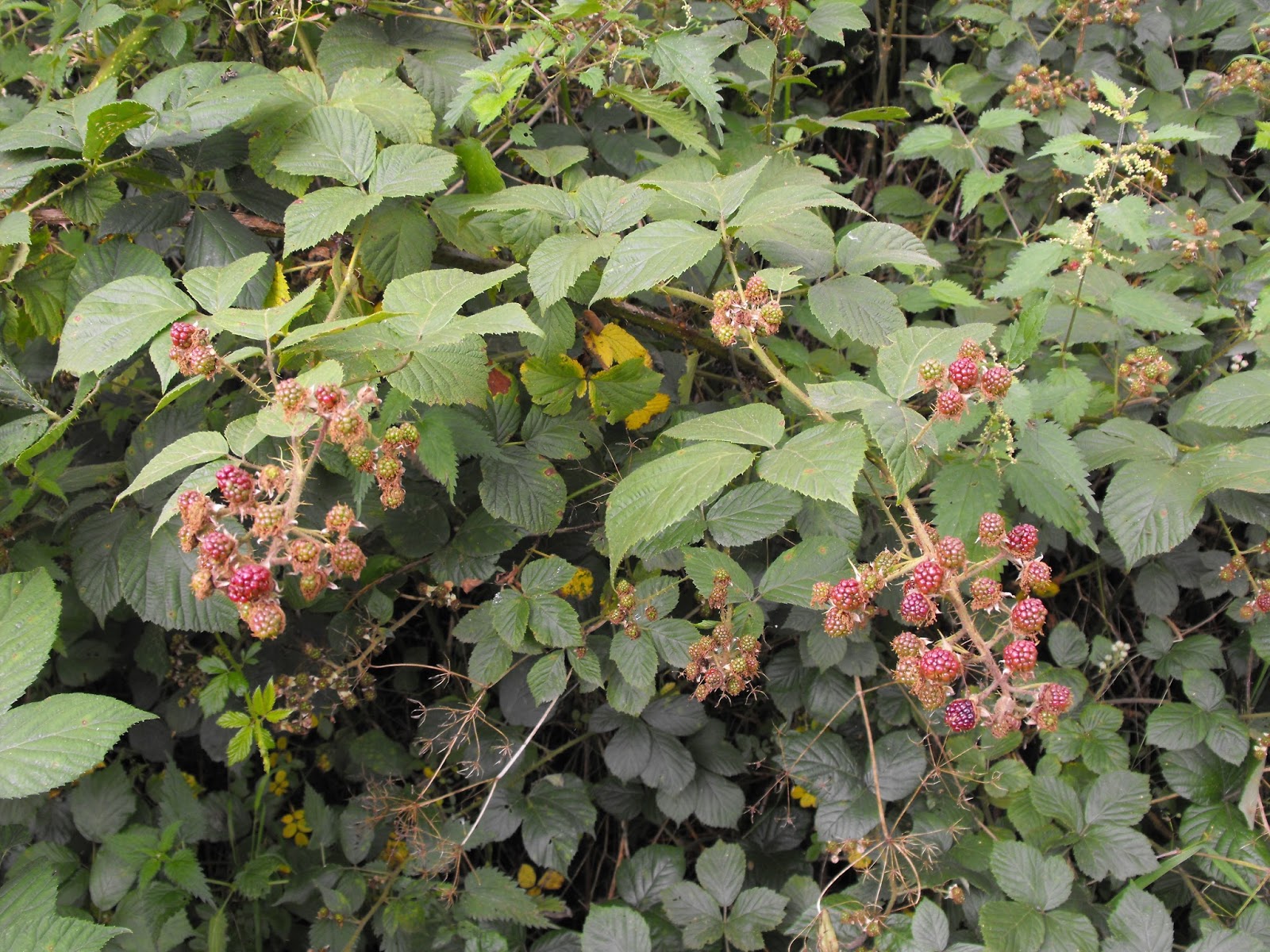
I ate my first blackberries of the season today - not off this bush, which has a way to go yet. One of the first signs of the approaching Autumn, along with the House Martins and Swallows who were swirling in an animated halo over the farm this morning, then forming a long line on the power line across the yard. Just as their arrival brings me joy, their leaving brings sadness . . . marking summer's end as it does.
Another marker of summer's end. A second flowering of a Foxglove cut back when they trimmed (trashed is more appropriate) the hedgerows back in June. A friend once told me that Foxgloves mark the passage of summer. Their first flowers show the arrival of summer, and their last flowers herald its end.
A few photos of bramble flowers, which are very photogenic, and very satisfying to draw as well. I love the frosted pink icing colours in these ones.
The one above is keeping company with the seed "bells" of the Navalwort flowers.
Finally, a pure white one. There are about 200 different types of Bramble apparently.
Just to prove I made it to the top of the hill, looking across to the Carmarthen Fans in the distance. We had planned a walk up to Llyn-y-Fan-Fawr this summer but we have been so busy. Perhaps when our eldest daughter and boyfriend arrive, we might get up there.
The view of the foothills at the back of the Carmarthen Fans.
Then the view across the valley, with Codlins-and-Cream growing in the hedgerow in the foreground.
A close-up of the ethereal flowers of Meadowsweet.
Above and below: back down the hill - looking up the valley.
Below: some Orpine which grows locally. I have never seen it growing anywhere else.
Finally, what a lovely colour the Cow Parsley goes at this time of year.
Well, we are having our "annual holiday" this weekend. Two nights away instead of the one which is normally our lot. We are heading down to Somerset and then on to Dartmoor and the weather is meant to be good.
Unfortunately, the car chose this week to have a hissy fit and had to have radical surgery yesterday, plus a couple of normal maintenance things like an oil change and two new front tyres. That made a hole in the exchequer, as did attending the auction next door! Some worthwhile stock though - much needed as we have a spate of fairs coming up at the end of the month.
Sunday, 7 August 2016
Resting today
Here is Alfie, pretending to be asleep! I wish I could join him. We have had two very busy days with early starts, then last night neither of us slept beyond 3.30 a.m. and as a consequence, feel rather shattered now. We dragged ourselves out of bed at 7 and without having even a cup of tea, shot straight down to the car boot sale in town, although on first wander round, we thought we would be coming home empty-handed. Fortunately another circuit and some new cars unpacking brought us some more stock for the Unit.
Elecampane in the border.
We had intended to attend a remembrance parade in Hay-on-Wye, in memory of the Somme, and its fallen, but with both of us too tired to drive anyway far, let alone a 3 hours round trip, we decided we would have to forgo attendance.
Shasta Daisies, beside the Elecampane.
This is a David Austin rose, with a Graham Thomas label, but it looks too peachy to me.
Here are two little pieces of jewellery I bought recently (VERY cheaply). Sadly, both are damaged - the elephant brooch on the left has lost the pin on the back, and a bit of poor chain is on the top (replacing an original necklace), so I shall try and rectify that. The little turquoise wheel brooch needs a dab of solder on the back too. I don't do jewellery as a rule, but need to learn about it - and silver too - as we don't want to be lugging round big bits of furniture into our dotage! Small and light . . .
I am just too tired to write any more at the moment, but hopefully a good night's sleep will put me back to normal again.
Wednesday, 3 August 2016
Leading from the front - 31st July 1916 - the Somme - in memory of Captain George Brown Bird

George Brown Bird was a career soldier. Originally with the 17th Lancers (the "Death and Glory Boys"), he joined up at 14 and was a Drummer Boy, going to the Boer War at a very young age. He was a very talented musician, and, as a Band Sergeant, had been given a place at the Royal Military School of Music. He had left India, where he had been soldiering, to take the Entrance Examination but unfortunately then was seconded to the Front, where he joined the 10th Warwicks.
By this day in 1916, my husband's great uncle, his grandmother's brother, Captain George Brown Bird, had been killed On this day in 1916, his Commanding Officer H W Deakeyne wrote the following letter to his widow Maggie:
"Dear Mrs Harrison
It is with very deep regret that I have to write to you to tell you of the death in action of your brother, Captain George Bird, who was killed very gallantly leading his Coy. to the attack of some German trenches on July 31st at about 6.16 p.m. The Regt. was told off to capture a line of trenches about 200 yards distant, and I gave command of the first attacking line to your brother. Although he personally never reached the trenches it was due to his splendid example and courage that the line never wavered and carried their objective. He was shot through the heart some ten yards from the trench , but had the satisfaction of knowing, before he died, that his objective was achieved. Knowing your brother as I did, and appreciating his character, I fancy he died perfectly content knowing his object had been achieved. Your brother was in many ways a remarkable and gifted man. He was a born soldier and leader. He was worshsipped by his men, who would do anything for him and follow him anywhere. Their perfect trust in him was a tribute to his character, and Tommy is no mean judge of character. A few days before his death, I had obtained permission for him to be my 2nd. in command, and his death to me and the whole Battalion is a loss that we can ill spare.
I beg to assure you that you have the very real sympathy of all the officers and men of the Battalion, as everyone realized that in the death of your brother they have lost a friend and a leader that it will be very hard to replace."
* * * *
Daily Chronicle, 11.9.16. Mention of George Bird's posthumus award:
BAR TO M.C.
The undermentioned officers have been awarded a Bar to their Military Cross for subsequent acts of conspicuous gallantry:
2nd Lt. George B. Bird, R. War.
For conspicuous gallantry during operations. When his C.O. had become a casualty, he took command and organized the defence of the line. It was mainly due to his good work that three enemy counter attacks were repulsed.
* * * *
For others, the ones who had been left behind, life went on in ignorance of the fate of their loved ones until that fateful telegraph arrived. George was a Scarborough lad. I am sure life seemed to go on normally, although Scarborough Castle was bombed and there were warships out in the North Sea beyond it. These were remembered by George's niece Alice (my husband's mother) when she was only 6 years old or so, and being walked near the coast to see family friends, the old Miss Boddy(s).
Sadly, the girl who would probably have become George's wife had he not died, heard the sad news from George's sister. Her letter (and other communications and newspaper pieces following George's death) is still in the Book of Memories compiled by Maggie:
"Dear Mrs Harrison
Many thanks for your kind letter, also copy of Col. Dakeyne's letter. You have my deepest sympathy. I am pleased to know the details. It is satisfactory to you to know how the end came. I miss writing to him very much, as I nearly always wrote a letter to him once or twice a week, and sent a newspaper. I am going to ask a favour of you, that is if you have a photo of him to spare, or likely to have any copied, I should be very grateful for one. It was great his being awarded the D.S.O. When he won the Military Cross I told him if he was a brother of mine I should be very proud of him. He always seemed of a retiring nature, his letters were not of a boasting character. His heart and soul seemed to be in his work. It is finished now. May he rest in peace. I trust you will bear up in your great sorrow, tho' his place can never be filled.
Yours truly,
Fanny G Moles."
I don't know if Fanny ever married. She lived at Bembridge on the Isle of Wight, so I am going to see if I can trace her.
There are other letters, replies from his superior officers, written in response to Maggie's heartfelt pleas for more information as to George's demise. The truth of the matter was that he was left in a shell hole, and once the trench was taken, his men went back to check on him. On the third occasion he had passed away. Sadly, they never got a chance to recover his body as the shell hole was bombed, and so George's name is on the Roll of Honour for the fallen who were never recovered, on the Menin Gate.
His medals for bravery and gallantry are still in the family, and much treasured.
Tuesday, 2 August 2016
Our losses in the Somme offensive - Bertie Ward Harrison

I have had these posts in mind for all of July. 100 years ago on 31st July 1916, my husband's great Uncle, Captain George Brown Bird, was killed in action. I will remember him tomorrow, as the 3rd August is the date that his commanding officer wrote to George's sister to inform her of her loss.
Just 3 weeks earlier, his brother-in-law, my husband's grandfather, Bertie Ward Harrison, had been badly injured. Initial news was that he was expected to live, having been shot in the back and the legs. This is the information which had been given to George Bird, when he asked after him, knowing his Company had been involved in house to house fighting in the village of La Boisselle. It was a rum do - no-one knew from one minute to the next whether the house which had been held by the Germans shortly before, was still in enemy hands or had been captured (briefly) by the British. The village was captured and held by the British on the 4th July, and it was on this date that Bertie was injured. If you visit the La Boisselle Study Group page, you will see a map which is copyrighted, so I can't show it here. Here is a link to some of the information about the area, and the huge crater (The Glory Hole) which was never filled in and is still in evidence to this day.
In the confusion of the dressing stations, perhaps George was misinformed, but sadly Bertie's injuries proved too great and he died on 5th July. Initially he was listed as "Missing". The news of his death was not passed on to his widow for some weeks. Within days of this she was to hear of the death of her brother. Her hair turned white overnight.
My husband has passed me the letters Bertie sent to his wife. Just three remain. They sound so down to earth but all the time you can see he knew that the outlook for the fighting Tommies was not good. When he was in hospital it is clear he was dreading going back but all the time he tried to keep positive. I guess many men wrote in a similar vein. I have added a little punctuation as Bertie often missed it out, but I think you will see something of the man in these letters. He was so good looking and apparently when he came home on leave, all the neighbouring wives would be round, as they thought he had film star looks and he brightened up their lives. Knowing what we do of him, I think he was quite a character and I am sure my husband has inherited his wicked sense of humour from Bertie. He was brave - he once had a shave in a lion's cage (for the money, which was always tight). He was a Bookie's runner for a while, but had some problems with that as on occasion he wouldn't put the bet on as he knew the horse and thought it couldn't run an inch, and then the blooming thing went and won, and he had to go to the Boxing Booths in Blackpool to fight and win the stake money back . . .
He and George will never be forgotten in our family. Here are the letters:
March 14th, 1916:
Dear Maggie
I got writing pad and twist alright. The Twist was a God send. I had just finished my other. Well dear, people seem to get alarmed over a bit of a air raid. I don't now what they would do if they had been like us for 34 days within a stone throw of the Gers and seeing your mates go under every day. Thank God we are out for a 10 days rest and then we shall be among it again. It's a treat to get away from it a bit if its only to get a clean change and a bath. I think George's Reg. is following us for a rest. I am going to try and find out today. . . . . .
I hope Edie is keeping alright. Also the rest of Friends. I am glad Alice is getting a clever girl. Let her write me a few lines next letter and see if she is improving. Tell George to be a good boy and go to school and then he will be able to write to his daddy. I hope baby and Agnes is well, also yourself. I must close now. Good bye and God bless you all. from your Loving Husband Bert xxxxxxxxxxxxx
Over the page he wrote asking for a weekly paper after Maggie had read it, as "we never see one".
Undated:
Dear Maggie
Just a line to let you know I have been here (the Gen. Hospital) nearly a fortnight, got a wound in the hand and it turned to poisoning, but glad to say I am nearly better. I shall be leaving here any day but write back to this address by return. it will follow me on. I haven't heard from you since September 9th. I feel so miserable. I came down here from the firing line after the big advance so I expect my letters will be there for me when I get back. I sent a letter from here a week on Saturday with a young chap, he was coming to England. I told him to post it when he arrived but I think he must have forgot it or lost it. If you had received it I know you would have written back straight away. I do hope you have got over your illness alright and that you are up again, its been hard for me not been able to get any letters. Of course if this had not have happened I should have got them alright and got to (k)now how you were getting on. I feel sorry at giving him the letter to post but I thought you would get it sooner. Now dear dont fret about me I am alright again. I shant be in the trenches for a week or so until I get moved. Have you heard from George yet. I would like to hear from him. It looks as if the War will last a long time yet as we gain ground here we seem to lose it on the other side. Its a treat to here our Guns sending the shells over our heads into there lines , the noise was terrible but the sights were worse. I never want to see it again. Well dear, I would like to tell you more about it but you will have to wait till I come home which I hope wont be long. Write straight back. Remember me to Mrs Wood and all. Has Jack come out yet if not tell him to hurry up, we can do with the big guns. I most close now, from Your Loving Husband Bert xxxxxxxxxxxxxx
March 14th or 15th (I don't know which he wrote)
Dear Maggie
Just a line to let you know I got your letter. I also receives twist and handkerchief last night. Well dear, I am glad you are alright. Sorry to hear Mrs Wood is bad again. Poor old Mrs. Tell her to buck up, the War will soon be over I don't think. Well Maggie, our Division is on Pass so in a month or two if I get through I shall be looking at coming home for a few days. Men thats been in hospital have to wait till the last I believe, but it wont take our company so long to get through as theres only a few of us left, its the Bombers thats touching out every day, you see we have to get very close to the Gers before we can reach them with our bombs but its God help them same as it is God help us when they drop among you, there terrible things. I have only just got my nerves right from the last big battle, what with their bombs and ours its a bit nerve recking. I hope I come through alright for your sake and the childrens. Tell Alice and George to be good children and go to school and then they will get on alright. Poor Samy Brotherton I only so him in the trenches two days before he got it, he laughed away and we had a s(h)ort talk. I never thought it would be the last time but its a old saying in the midst of life we are in Death and now I must close and Good bye, from your Loving Husband Bert. xxxxxxxxxxxxxx
Bertie died on 5th July 1916. He was 27. Many years before, In Scarborough, a gypsy had told his fortune for him and told he he would die when he was 27.
Monday, 1 August 2016
Bulorns, Kenacks and Lizamoo . . .
I have a fuddled brain here - after the exhaustions of the early part of last week, then the disappointment, then preparing for yesterday's Fleamarket on the showground in town, today has been a bit of a catch up day. I also managed to book two nights away for ourselves in the West Country. I wish we could manage longer away, but that's the best we can do. Mind you, judging by the price of B&B accommodation, I'm surprised I managed to get anywhere under £100 a night! That's the price you pay for trying to get away in August. We have a night in Somerset and a night on the edge of Dartmoor, so I am praying we get dry weather.
(Hay bales made from the grass in our top field).
I bought myself a book at the Fleamarket yesterday. "Words from the Countryman", edited by Valerie Porter, and published in 2007. It had extracts from the very earliest Countryman magazines (some more of which I bought recently when a friend was offering them cheaply) and is ab absolute delight. There were two short pieces about people with rat problems dealing with them by having Guinea Pigs in the vicinity - one was in Portugal and the other in Africa. I should think the Guinea Pigs were left loose to deal with the vermin, as they talked about one GP boar having tattered ears from fighting. Who would have thought?
Here is another delightful extract:
"One evening in May my wife and I found the children's roundabouts in Fitz Park, Keswick, deserted but not for long. Sheep which had been grazing walked to one of them, and the leader jumped on the platform, setting it in motion. As others quickly followed, its speed increased; and the whole flock had a ride, jumping on and off, some more than once. We were told that this had happened many times when no children were about . . ." R W Barnes.
Some of you will remember my fascination with rural language especially in the West Country, and here is another contribution from the Countryman:
"My Cornish ex-sailor gardener is 'some old tung-tavas', but between intervals of chatter he does useful work on my splat of ground. He takes a braave spur (good while) to get through, but he can always find time to smell the gillyflowers and to notice the thrush at its anvil breaking snail-shells, or as he puts it, 'the grey-bird scattin' the bulorns' - sometimes he calls them jan-jakes - 'to sherds'. He digs a straight vore for the beans, pausing to throw a bully (pebble) at the cat because she chased away a pedn-paly (blue tit). With his garden fork, which he calls an evil, he lifts a burn of dried grasses for the mabyers' (pullets') nests, and he gives them a few kenacks (worms). Mizzle or skewy (showery) rain is good for sticking plant, by which he means planting out all types of cabbage and broccoli and stanking or treting them firm in the ground. The soft weather brings on the weeds - drill-draw, keggas and lizamoo, known to me as small bindweed, hemlock and cow-parsnip. Weeding he finds 'a sparey (tedious) ole job' and cutting the skedge (privet) not much better. The rain always seems to come when he has a few tubbins (turfs) to burn; these and damp cricks (twigs) in the bonfire make some smeech. His griglan or heather broom is handy for sweeping paths or to place in the arm of the bucca, whose realistic hand-painted face frightens more than the crows. A day too wet to work in the garden is 'a day gone in to the King.' Gladys Hunkin, Cornwall.
I hope to have the time to write a proper and fitting tribute to our family's men who fell in the Somme - my husband's Great Uncle George Brown Bird and my husband's grandfather, Bertie Ward-Harrison. Their sacrifice will never be forgotten by our family.
Thursday, 28 July 2016
CANCELLED
Yes, that's right, they CANCELLED yesterday evening. Obviously in the area as yesterday was a possible viewing day had I gone for it, they must have done a drive by. They said: We have reviewed the location of the house again and have decided due to the general area, it is not for us therefore we would like to cancel the viewing please."
So there you have it. 2 x 12 hour days and a 6 hour day of housework and gardening to try and make it as perfect, clean and tidy as I could (imagine spring cleaning a 19 room house and you will know how exhausted I am today), all for nothing. I have never driven myself so hard, and if I hadn't had the garden to do too, could have got the house up together in a day. The garden is another matter though. I can't garden much in June because pollen levels affect my asthma, and of course everything grows like crazy. I was away for much of a week and we have been very busy with sourcing and selling stuff for my small business. Cutting back and weeding was the equivalent of "cutting" an acre of grass with a pair of tweezers . . .
So, either they couldn't cope with living next door to a farm, although it clearly states we are situated next door to a working farm, or we were deemed too far from the shops and amenities. Their loss. As Pattypan said, our house wants special people in it, and they weren't special . . .
Tuesday, 26 July 2016
A viewing looms
We have a viewing on Thursday at 1.30 p.m. Please think of our lovely house and hope that the folk fall in love with it . . . and buy it . . .
Subscribe to:
Posts (Atom)