Monday, 15 April 2013
Better than jewels by far
Just a quick update before I go on to Part II of my birthday bash! I wish it was as green along the river now, as in this photo above, but we are slowly getting there.
We had a good morning at the car boot sale yesterday, despite torrential rain, and I have to say, getting bargains is better than jewels by far to me! I found a Karen Maitland book I'd been looking for - hardback too - Falcons of Fire and Ice; a brilliant book on Rag Rugging (all sorts of projects in there and in typical Aries fashion I want to make them ALL!). I found a virtually brand new slow cooker for T for a couple of pounds (works well, as I tested it yesterday and made a beef casserole in it). Then a pretty very early Victorian jug (small one) which has gone up on a beam; and half a roll of 1985 Laura Ashley material - chestnut brown with a thin black and white stripe and oak leaves either side of the stripe. Looks nicer than it sounds. I also got T a 1970s round cushion with broderie anglaise edging and a crochet centre with a ribbon through. JUST her sort of thing as she loves vintage. My husband got plumbing bits and a cracking old Victorian axe made by Gilpins of Cannock. I shall have to behave myself now!
Friday, 12 April 2013
Part II of my birthday outing - the Misericord figures at St Mary's Priory Church -
Apologies for the delay in getting this all set up but I've had a busy week, with a Horspital appt, blood tests etc and offspring visiting and leading me astray with celebratory red wine! Anyway, hopefully I will be able to post a few more photos today without having to store them on Picasa first!
I fell in love with this little dragon carving on the Misericords (top photo). Like the Jesse figure, he dates from the 15th Century. I think this lion-headed one is an English dragon. He looks like his head and possibly wings have been cut off and then stuck back on or even re-carved (bless them) - perhaps the ravages of the Cromwellian henchmen in the area. And he has friends . . .
This twisty dragon looks a nastier piece of work altogether!, although it would appear he too was decapitated at some time (and possibly lost his tail too). Perhaps this one is the fierce Welsh dragon!
Then there is a lovely Mastiff:
He is worn smooth from years of stroking . . .
Opposite him is this little lion, another one who had his head knocked off and had it replaced in later times judging by the change of colour. I love his tawny tresses. So beautifully carved.
There is a beautiful female effigy (well two actually) in the Lewis chapel, which is believed to be that of Eva de Braose, who died pursuing her tame red squirrel around the castle walls (she fell . . .) "Someone" (we can guess who was to blame) chopped that squirrel off, but she still wears the chain around her waist, to which it was attached. I forgot to get a photo as we were so stunned by the Jesse figure. Next Time.
If the name of de Braose seems familiar to you, it may be because you have read Lady of Hay by Barbara Erskine (her best book, in my opinion). I have read it several times now and it has a lot of immediacy for me, because I know the area quite well. William de Braose (who would have been a benefactor of this church) was a thoroughly nasty piece of work, for all his (sham?) piety . . .
Because of the connection between the Lords of Abergavenny and the Tudors, the Priory became the Priory Church at the time of the Dissolution of the Monasteries. The Herbert chapel was saved from damage because of Sir Richard Herbert's connection with the young Henry Tudor (they were raised at beautiful Raglan Castle together) and Henry became Henry VII after Bosworth. In the details about St Mary's on Wikipedia, Sir Richard Herbert's support of Henry Tudor at the Battle of Bosworth was noted.
Some of the stone carvings were a little . . . ambivalent? I think this was a lion, or a lamb, though it looks like a camel with modified ears too!!!
I think this was a calf (fatted or otherwise?) as it had a cow-type tail. Might be a sheep though . . . St Luke had an Ox as his symbol and St. Mark had a Lion . . .
Another photo to try and give you an idea of how large the carved animals in the footrests are. As you can see, this is one of the memorials which got hacked about a bit and two arms are missing . . .
Another one with a calf/lamb??? query over it. Though you could say that's a dog's tail . . .
Wednesday, 10 April 2013
My birthday outing
We stopped off in Abergavenny on the way, to visit St Mary's church, as a television documentary the previous week had shown the most amazing 15th C carving - done on an entire huge oak tree - of Jesse, the father of King David. It is a unique piece, and probably one of the few remaining late Medieval wooden carvings remaining not just in Britain, but in Europe/the world.
Sadly the tree with branches of Jesus' family which was once a tall branch sprouting from Jesse's hands, was sawn off - quite probably after Oliver Cromwell's troops were in the area. With the window behind it, the light was very bad for taking photographs, but I hope these two show some of Jesse's majesty and the skill of the carver.
Anyway - more to follow - chasing my tail right now!
Thursday, 4 April 2013
We found him - "old" George Bird that is
We were about to go home after meeting up with our son in town yesterday, when out of the blue my husband suddenly suggested that we go to the Records office and see if we could find "Old George Bird" - his great grandfather. For some reason he had been very elusive in the Death registry and we simply could not find him where we thought he ought to be! Born in Herne Bay, Kent about 1848, by the 1861 census his parents had already relocated from Canterbury to Poplar in London. There he was, aged 13, with one of his older brothers, Walter 18, parents Samuel (41) and Maria (36) and her brother George Brown, a painter. They were living at 2 Elizabeth Terrace.
We had tracked him through until we lost him in the 1911 census, nowhere to be found. My husband suggested that as he was a joiner, who usually worked on ships in the Dockyards, perhaps he had been taken on a voyage to do running repairs. We will have to keep looking for those missing years. In 1901 he was in Limehouse, lodging with Mrs Bennett and her husband (an Ironworker) and young family. Family history has it that Mrs Bennett was a member of the Dickens Society and apart from his daughter, the only other person at George's funeral. George was also listed as an Ironworker on the 1911 census, so he obviously turned his hand to whatever might earn him money.
He had married Emma Righton, in Scarborough, and they had a son (George Brown Bird) and a daughter, Maria Margaret. She married him in Poplar, but couldn't live there (hated it). They moved back to Scarborough, and apparently HE didn't like it there, but I think, looking at the photo, he was a fairly uncompromising personality and so perhaps the marriage failed and he went back home to Poplar. Quite how they met I can't say, but she let rooms in her Oxford Street house and was a laundress, and perhaps he was following the work on the boats and they may have been dismantling them at Scarborough and he took a room with her.
Anyway, poor Emma continued to take in washing after George moved out, and unfortunately when she took in the washing from the travelling circus (which must have been a regular occurrence as Doodles the Clown once asked her to marry him, pre-George one assumes) it was infected with Smallpox and she caught it. Family history tells of meals being pushed along the top of the wall with a pole, so that the family were fed. This was due to the kindness of her neighbour, but the neighbour risked catching Smallpox too - perhaps they soaked the plates in disinfectant before they were returned for the next meal? Emma died the following year, from kidney problems resulting from the Smallpox I believe.
In 1916, his son, George Brown Bird was killed in the early days of the Somme offensive. By this time Maria Margaret had moved to Manchester, as a Scarborough laundry owner was setting up a new laundry there and wanted her to run it for him. Old George turned up on her doorstep, very upset over his son's death, and wanting to see his daughter (possibly one last time) before he went off to fight the Hun and avenge his son's death. He looked younger than his age - he was 68 when he enlisted but took 10 years off (he was 70 in the photo above), and they obviously believed him as he was signed up as a Sapper in the Royal Engineers and sent out to Mesopotamia, Chronic Bronchitis and lack of stature (he was 5 feet and 1/2 an inch tall) not withstanding. He served with the Royal Engineers for 2 years before catching Malaria and being discharged on medical grounds and sent back to convalesce at Netley Hospital (a couple of miles from where I grew up and where I used to walk the dogs as it was demolished and the grounds turned into a park before I left Southampton for good). Whilst at Netley Hospital he caught Scabies . . . His initial Army pension was 27/6 (about £1.35) for just the first week, looking at his Army service record, and then 11/- (11 shillings - about 60pence these days) to be reviewed about 48 weeks. Presumably that was enough to scrape by on.
We have assumed he went back to the familiar streets of Limehouse, and "got by". Family memories say that Maria Margaret went to London to collect her brother's medals at the Palace (George had been a brave and capable leader of men - the Army was his career, and music his great love) and within a year or two she was back for her father's lonely funeral at Bow Cemetary. My husband had always assumed that the medals were awarded a year of so after young George's death, but it is more likely to have been a year or so after the very end of the war. Anyway, we had been looking too soon for Old George's death, and weren't sure if his age would have been put down as actual age or what-he-told-the-Army age . . . In the event, we finally found him yesterday, George Bird, in the July-Sept. 1/4 of 1922, age 74, in Shoreditch. Horrified to find price of his death certificate will be £13.99 (12 days before delivery). If we want it by the weekend, it will only cost us £74.99!!!

Wednesday, 3 April 2013
A poem for April
APRIL
Cosied in the hedgerow,
Rose Campion stands,
A foil for the trembling Cow Parsley.
A flock of Starlings jinks like a tantivy Whippet
And a crow, nightmare black,
Tiptoes on a treetop.
Mayblossom springs on arching sprays,
Hunched on a hillside
Like a Buzzard shielding its prey.
Buttercups freckle the fields
And tickle the noses of grazing cattle
In fields dissected by the slash of a hedgerow,
Curving past the memory of a long-forgotten cottage.
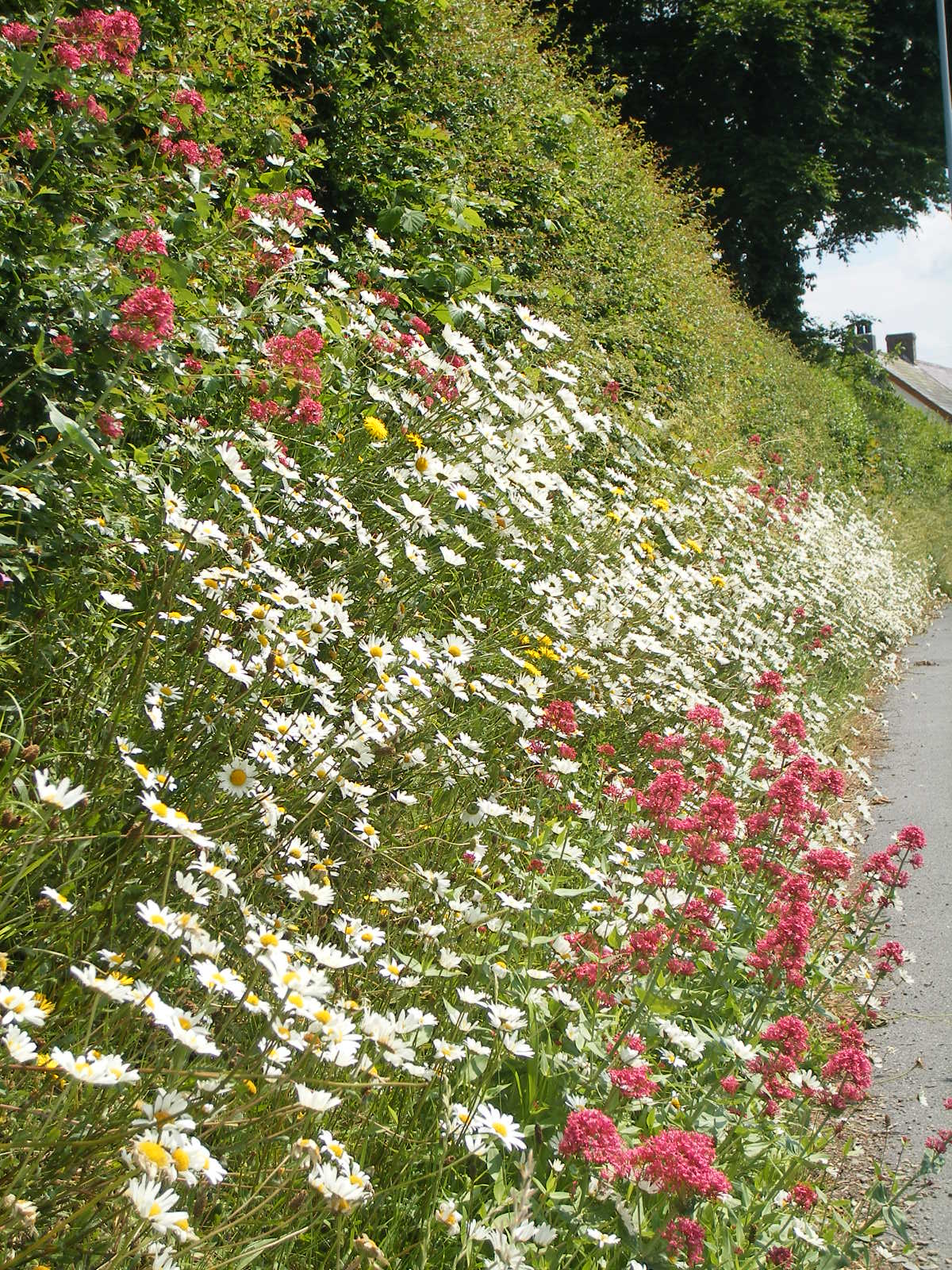
This is one from my Common-place book and improved upon a little as I typed it up today. The photo of Campions annoyingly eluded me (I have so many photos on here), so this is Ox-Eye Daisies and Valerian on the cusp of May.
Tantivy, incidentally, is a little-used word meaning flat-out gallop, full-pelt . . .
Tuesday, 2 April 2013
Queen of the Gypsies
I couldn't sleep last night. At 1 a.m. I took painkillers, but my mind wouldn't stop working and so I crept out of bed, and wrote this:
QUEEN OF THE GYPSIES
Gap-toothed and clothed in the black
Of perpetual mourning,
She lived a half-life,
In an old wooden cabin, behind
Greying net curtains and
Four waving pine trees.
I knew her for a witch.
On Sundays her sons came visiting,
With the dock-tailed cob and the trolley cart,
Leading Mandy to the shed around the back
They tied her up.
Dutifully they took tea,
Watching as Queenie mumbled seed cake.
Bringing her coal and kindling, they
Told her how their families got on,
Feeding her gossip eough for the week,
And left.
If I was playing by the cherry tree,
She would always notice, and
Cross the road, fumbling her apron pocket
And pinching my cheek with sandpaper fingers.
She would smile horridly, and
Press a pack of three wrapped biscuits in my hand.
They were always soft.
This evokes such strong memories in me, and I am back living in the 1950s in my head this morning. I can still feel the fear of seeing the "witch" coming towards me.. . Bless her, she must have been so lonely, and had obviously been a loving mum.
Hopefully I have just got rid of the white background and green lettering that came from typing it up as an office document, and then cutting and pasting.
QUEEN OF THE GYPSIES
Gap-toothed and clothed in the black
Of perpetual mourning,
She lived a half-life,
In an old wooden cabin, behind
Greying net curtains and
Four waving pine trees.
I knew her for a witch.
On Sundays her sons came visiting,
With the dock-tailed cob and the trolley cart,
Leading Mandy to the shed around the back
They tied her up.
Dutifully they took tea,
Watching as Queenie mumbled seed cake.
Bringing her coal and kindling, they
Told her how their families got on,
Feeding her gossip eough for the week,
And left.
If I was playing by the cherry tree,
She would always notice, and
Cross the road, fumbling her apron pocket
And pinching my cheek with sandpaper fingers.
She would smile horridly, and
Press a pack of three wrapped biscuits in my hand.
They were always soft.
This evokes such strong memories in me, and I am back living in the 1950s in my head this morning. I can still feel the fear of seeing the "witch" coming towards me.. . Bless her, she must have been so lonely, and had obviously been a loving mum.
Hopefully I have just got rid of the white background and green lettering that came from typing it up as an office document, and then cutting and pasting.
Monday, 1 April 2013
New Blog about Edward Thomas
I have just been tinkering with a separate new blog about Edward Thomas. I have put the link on the side bar but you will have to cut and paste for the moment. When you get there, the Header picture is enormous and I have to work out how to lessen it. Posts so far are just copies (or partial copies) of earlier blog posts from here about the man and his work.
He has needed his own space for a while. I shall be posting there regularly but not daily.
Subscribe to:
Posts (Atom)